Friday, 17 January 2014

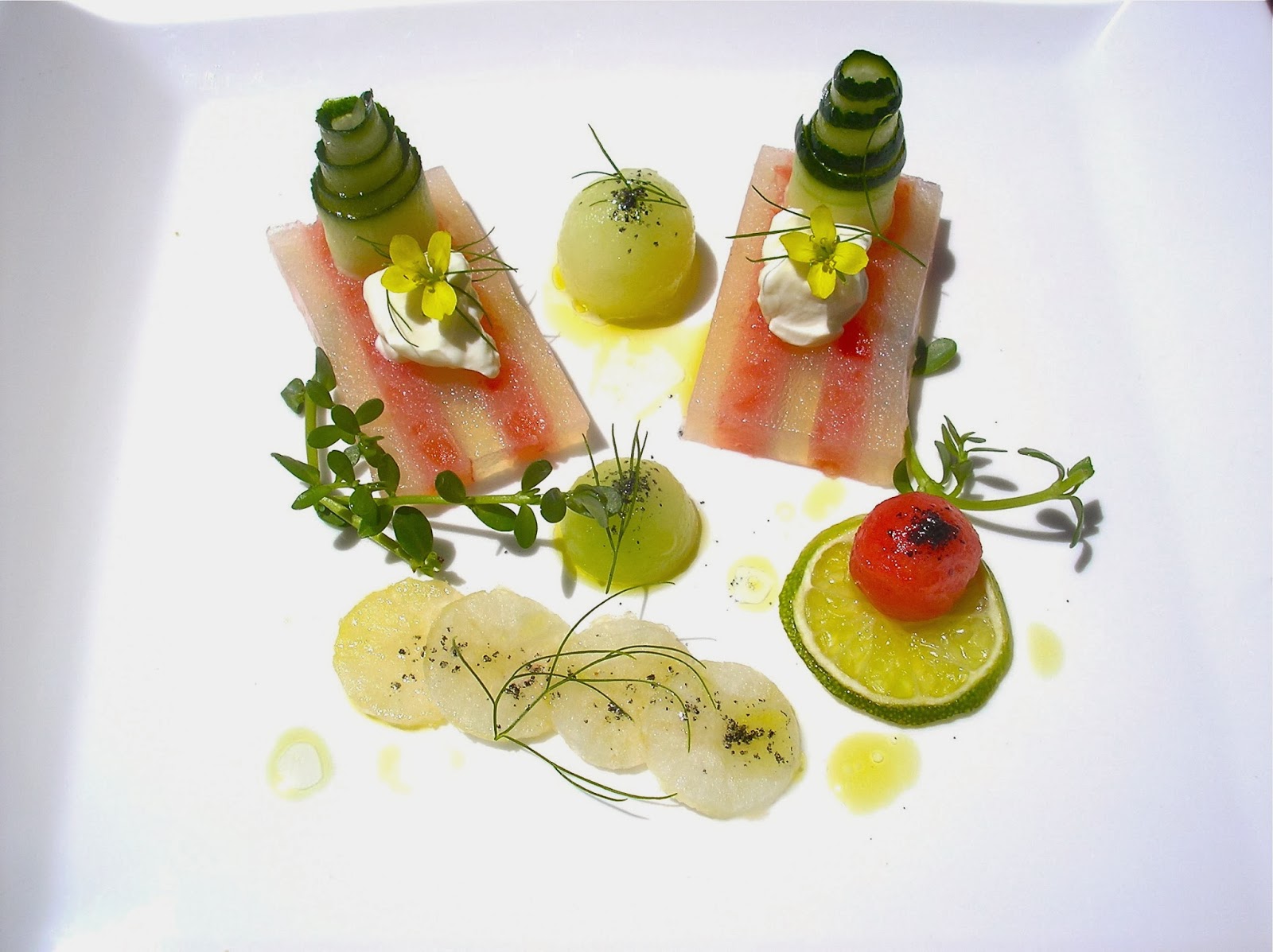
' CUCUMBER and MELON TERRINE .'

Terrine of Cucumber, Watermelon & Honeydew with Horseradish , Persian cucumber , Melon balls , Lime slice , Water hyssop , creme fraiche , fennel fronds , wild rocket flowers ,  lime vinaigrette & cypress black salt. 

                      This is another classic pairing, the summer fruits of cucumber and melons, this little dish served ultra cold makes a perfect refreshing appetiser. This dish gets the gastric going and the saliva flowing with hints of zesty flavours from the lime vinaigrette, the salty sweet taste of the different melons and the little bite from the radish, rounded off well with the delicate flavours of fennel fronds and water hyssop herb. Melons are in full season at the moment as are cucumbers and I wanted to incorporate the two in a dish that was light, colourful and refreshing. The herbs come from the garden but the rest of the ingredients come from the Italian grocery store I frequent in the inner suburbs.
                     I started preparing this dish the night before beginning with the terrine, which consisted of first chopping, deseeding and pureeing separately in a blender cucumber, honeydew and watermelon. Placing each puree into a separate bowl, they were seasoned with salt and pepper and measured out before being separately simmered in a small saucepan with 1% agar agar, whisking to dissolve the agar. Each was removed and layering one at a time beginning with the cucumber I poured the mix into a greased plastic mould. Placing the mould in the fridge between layers to set them faster I then followed with the watermelon and in order honeydew, watermelon and cucumber last. The whole terrine was then placed in the fridge over night to fully set before being turned out and sliced the next day. To make the cucumber spirals I simply sliced a thin strip of cucumber using a peeler, trimmed the ends and rolled it up tight before pushing from the bottom using the back of a spoon to unravel the roll into a spiral, filling the bottom with a dab of creme fraiche to hold it together and dressed with vinaigrette. I cut the melons simply using a melon baller and these to were dressed with vinaigrette and finished with a sprinkle of black cypress salt. To prepare the the horseradish I just peeled them before thinly slicing and dressing them in the vinaigrette and sprinkled black salt for contrast. The vinaigrette was a simply blend of lime juice with extra virgin olive oil. The additions to the plate also were creme fraiche, fennel fronds, a lime slice, fresh water hyssop and tiny little yellow edible wild rocket flowers.


Monday, 13 January 2014

' WILD SESAME LEAF with KOREAN PORK .'

Deulkkae Samgyeopsai translates:- (Wild Sesame Leaf with Korean style Pork) , steamed rice , chilli sauce , mini birdseye chilli and garlic chives .

           This particular little asian entremet was inspired by the purchase of these Sesame leafs which I got from a Korean store on Elizabeth St. in the heart of Brisbane city while my eldest son Caleb of five and I were visiting the museum for a dinosaur display. I've seen these leaves before but never used them or tried them in fact. These leaves have the name 'sesame' but are actually not from the sesame plant that bares the sesame seeds. When the leaves are used freshly chopped through salads or used to wrap rice and meats they part an apple and mint flavour giving a fresh light finish. This dish is my take on the Korean street stall food presenting one wrapped and one open to wrap one-self. I have since learnt that this particular plant grows exceptionally well in an aquaponic set-up.                                
            To make this dish I first marinated pork belly in soy sauce, sugar, rice wine vinegar, minced ginger, crushed garlic and red chillies overnight in a ziplock bag in the fridge. The pork was then removed from the bag and pan fried in a hot skillet until sealed brown on both sides this was then placed into a roasting pan and placed into a 190 deg.c. oven for around 15-20 minutes. The pork was then rested for 5 minutes before being sliced to serve. The sauce was made by mixing together in a bowl crushed garlic, ginger, coriander, sesame oil, chilli paste and chopped coriander.                              
           To plate this taster I presented one on the plate made and one for the diner to roll themselves, I first placed a washed fresh wild sesame leaf shiny side up centrally on the plate. Placing a spoon of steamed rice on top accompanied by small pieces of the pork before spooning on some chilli sauce and garnishing with the chopped chives and mini birdseye chilli. I then placed the prepared roll behind that and spooned some chilli sauce on the plate next to them in the shape of a chilli. Next time I would have sprinkled some toasted sesame seeds atop as intended this time but lapsed my mind while plating. To be honest I haven't been impressed with the overall plating of this dish and was going to be scrapped if it were not for the incredible taste and simplicity in preparation. Trying to jazz this one up will be a future challenge as I think it can be a winner if giving the right attention to detail.


Saturday, 11 January 2014

' CHILLI SUN-DRIED SQUID .'

Ojingeochae Bokkeum translates:- (Chilli sun-dried squid) , Fried egg noodles , Squid ink , toasted sesame seeds , ginger mint , kaffir lime leaves , garlic chives and edible flower.

               Distressed squid caught in a discarded boat net is how I describe the forth of a series of five asian inspired tasters that has dated back to the New Years Day post. This is my version of a Korean dish in which traditionally the squid is shredded and prepared in the same manner presented here. Usually served with rice, I've left the squid whole and the rice out adding the fried noodles instead accompanied by the squid ink, garlic chives, ginger mint and edible flowers to bring it all together. The squid with a little bite from the chilli has a chewy texture similar to jerky but it breaks free easier in the mouth with a fishy flavour. The sun-dried squid was purchased from a Korean store in the city and the squid ink used for this dish comes imported from spain in four individual wrap 4g satchels and were purchased from a gourmet food trader in Fortitude Valley called the 'Black Pearl Epicure'. I used about half a satchel for this dish and it needs a little mixing like a fresh tin of paint as it has some lumps through it. This ink comes from the squid as suggested and is blue black in colour, ink can also be harvested from octopus which produce a black ink or cuttlefish producing sepia (brown). Ink was used for printing in the earlier days and is a defence mechanism used by these species, as its sprayed from the under side of the squid in this case warning off predators. Squid ink has a mild well rounded taste of the ocean and doesn't mimic any of the sea creatures in taste even that of its own producer.              
               To make this dish is very simple and starts by soaking the sun-dried squid in cold water for about 10-15 minutes. While this is soaking I brought a small saucepan of salted water to the boil and cooked some egg noodles, these were then drained arranged into two piles and shallow fried to crisp them up. In a separate saucepan I placed chilli paste, honey, soy sauce, minced garlic and rice wine and brought to a simmer. Once the sauce is mixed and heated I added the drained squid and coated well simmering for about another minute or so until the sauce is almost dry. The squid was then removed from the heat and set aside to plate. In a skillet I lightly toasted some sesame seeds just enough to release some oils and give maximum flavour to the dish.                                                                                          
                In presenting this plate a first placed a brush stroke of squid ink on to the plate using a pastry brush. In a pile at the start of the brush stroke I cut short lengths of garlic chives from the backyard to resemble seaweed or sea grass. On top of this I placed the first nest of noodles and arranged the tip of the squid head on top of the noodles. Placing another nest of noodles on top of the squid to look like the squid has swam into the netting of noodles and released ink in distress. On the the remaining section of the head showing i sprinkled the toasted sesame seeds and to garnish the dish I placed shredded kaffir lime leaves, a ginger mint sprig and cinnamon myrtle flower on top of the fried egg noodles.


Monday, 6 January 2014

' COCA COLA BRAISED CROCODILE PAW .'

Asian style Coca cola braised Crocodile paw , Hawaiian sweet potato puree , Cola broth reduction , Water hyssop (Brahmi herb) , Ginger mint and Wild spinach flower.

             This isn't the first time I've used coca cola to braise meat, it does a fantastic job, nor is this the first time cooking crocodile paw this week. But as far as braising 'Croc in Coke' its a first. Earlier this week I made char grilled croc hock with a fresh made banana flower salad and it tasted fantastic on the blistering hot summer day it was. On the last day of our holidays on the coast, I came across a small shop in the heart of Surfers Paradise, they'd only been open for a week. 'Fortune Abalone Australia' are traders in world delicacies and it was the massive mason jars standing half a meter tall filled with deep sea cucumbers that caught my attention whilst walking past. Well really it might have been the price label of AUS. $1200 / kg for these sea melons from the abyss. They had snake, birds nests you name it and as I pried further with curiosity, my wife clung tighter in desperation to my two boys, so they couldn't knock anything over. At the back of the shop these crocodile paws caught my eye from a chest freezer, when I saw the price $6 for two hocks I had to get them and along with some tail fillet, we walked out of there with some fairly cheap (Australian standards) croc meat and the boys managed to avoid a second bill (the damages). This crocodile meat comes from a farm in Cairns Nth. Queensland and comes available washed, skinned, vacuum packed, frozen and in various cuts. The asian cola broth paired with the sweet potato is just heaven, add the croc paw just tops it off. Crocodile paw cooked this way by far surpasses the textural highness of braised chicken feet. The dish was finished off with the renowned brain herb Brahmi or Water hyssop which grows with much vigour at this time of the year. Along with watercress and kang kong (water spinach) they make up the natural plant filters in my solar aquaponic pond set-up which I grow Red-claw yabbies.                                                                          
               To begin I started by defrosting, washing and cutting the croc hock to the portion sized paw, this was then boiled rapidly in water for 2-3 minutes before removing, discarding the water and washing the pot to start the broth, this process removes any unwanted impurities before braising. Into the pot I put the croc foot with one part coke to two parts water enough to cover the paw. Adding to this a quarter part of each soy sauce, dry sherry and panela (evaporated sugar cane juice) along with red chilli, ginger, star anise and cinnamon stick this was brought to the boil before reducing to a simmer for around 45-50 minutes covered and turning the paw twice each side during this process, this was removed from the heat and set aside. During the braising process I peeled some Hawaiian sweet potato cutting into equal pieces I placed them into a pot of cold water which I brought to the boil until the starch was tender of which I then drained and placed into a blender with a little seasoning and some milk and blended to a rough puree. To make the sauce I simply poured some of the strained cooking liquid into a small saucepan adding a little more panela and some xantham gum I simmered the sauce until thick and reduced.          
              to plate I spooned some of the reduction onto the plate dragging the paw through the sauce I then spooned some puree topped with water hyssop opposite the sauce placing the croc paw on top of the puree and finishing the dish with a little ginger mint and a wild spinach flower.


Wednesday, 1 January 2014

' CONGEE with PRESERVED DUCK EGG .'

Congee with Pork & shallots , Preserved Duck egg ( century egg ) yolk , white & soft centre garnished with micro tea leaves & green shallots.


          During the break while holidaying on the Gold Coast I went on a mission to find a good asian grocery store to buy ingredients for the sharks fin soup and what ever else caught my eyes. In a fridge section they had an array of duck eggs, there was fresh ones, salted ones, pickled ones and the century eggs or preserved duck eggs. They came washed and ready to peel or like the ones I purchased, still coated in the salt, calcium and tea leave mixture. I know a couple of ladies at work that preserve their own eggs and love the whole experience, but myself and I'm probably speaking for a high percentage of westerners preserved eggs are best sampled sparing and accompanied. As you would not eat a whole garlic or truffle as you probably shouldn't eat a whole egg. These eggs aren't really century old eggs but rather eggs that have been preserving for a few months, long enough to change the colour and textures of the duck eggs. Over time the white of the egg becomes jelly like and a translucent amber colour as the the yolk turns a greenish black and looks like rotten egg with a sulphur smell. In this asian breakfast taster I've paired the egg with congee which is a rice porridge dish served at breakfast or late supper or particularly when ill.                                                                                                                                      
          To make this taster spoon I first made the congee by soaking white rice in water for an hour before bringing to the boil with 18 times water in weight. To this I added pieces of shredded ham, ginger, green shallots, salt, pepper and a little sesame oil this was then boiled until the grains of rice had  become soft and largely disintegrated. The preserved egg was washed to remove the tea leaves and salt mixture and then shelled revealing the amber, greenish black jelly like egg. This was then sliced to be presented in three forms the white, the hardened yolk and the soft centre of the yolk . These were arranged on top of a spoonful of congee and garnished with micro tea leaves and green shallots.


Monday, 23 December 2013

' MERRY CHRISTMAS EVERYONE !'

Warm Fig Bread pudding , Bourbon and butter sauce , Drunken sultanas , Blood orange marmelade , Bourbon glazed walnuts , Chantilly cream , melted chocolate and mint leaves.


        First off I just want to wish everyone a very merry and safe Christmas and New Year and thank you all for your support and kind words over the past few months, will be back to blogging in the new year. This is a little take on things christmasy and with the alcohol makes you warm and festive.
       For the fig bread pudding I poached dried figs in red wine, thyme and sugar until soft. The figs were then blended to a puree before adding cream, milk and sugar. In a large bowl I cubed white bread and poured the mixture over the bread and allowed the bread to soak up the liquid. I then spooned the bread mixture into greased muffin tray inserts and baked in a 180 deg.c. oven for about 25-30 minutes. In a fry pan I dry roasted some chopped walnuts adding to this butter and sugar, coating the walnuts. I then poured in some bourbon and simmered allowing the mixture to reduce and thicken to a syrup. The nuts were then removed and set aside. The cream was simply whipped thickened cream, icing sugar and vanilla extract. The marmalade was made by simmering down blood orange juice, zest and sugar to a jam consistency. The sultanas were steeped in Jim Beam bourbon overnight and this was the bourbon used to make the bourbon butter sauce.
        To plate I placed the bread pudding in the centre of the plate spooning the bourbon butter sauce over the top of the pudding and pooling the sauce around the base of the pudding. I then piped some chantilly cream on the pudding and on the plate at 11 o'clock, 2, 5 and 8, each dollop of cream received a mint leaf. Next I placed the candied walnuts to the left of each cream on the plate following with the melted shaved dark chocolate then the marmalade and finishing with the drunken sultanas.


MERRY CHRISTMAS !


' DRAGON-FRUIT & PASSIONFRUIT .' dessert

Dessert of Passionfruit Tartlet , panna cotta , gelato , fruit pulp & fruit leathers , Dragon-fruit Chiffon cakes , sorbet , fresh red and white fruit , Shortbread crumble , Chantilly cream and micro mint leaves. 

                    This is a little fruit demonstration uses just 2 fruits as apposed to the two 16 fruit medley posts earlier on. But in this I have demonstrated 3 or more preparations for each fruit varying the textures and visuals in each to keep the diner from straying. Both these fruit grow in my backyard and the passionfruit  used for this dessert is backyard harvested, frozen from last season. About 5 or 6 years ago, quite a large tea tree on the side of our property snapped in half during a summer storm. The bottom half of the tree plays host to some staghorns and fortunately the tree kept growing and from that day on the tree was not only host to staghorns but a rouge panama gold passionfruit vine. Never knowing the origin of the vine or even where the vines root system is, to be able to water it. The vine continued to grow and engulf the tea tree giving us seasons of gold large full fruit. That is until a year or so ago the vine died off and now we may get the odd fruit here and there. So the pulp used for this dessert was he last harvest from the mysterious panama gold vine. Our dragon fruit cactus were grown and reared from seed about 8 years ago, they've recently been transplanted outdoors from out of the green house they haven't given us any fruit just yet, so the red and white varieties you see on this plate have been store bought.    
                    The preparations for this dish are listed below in order of method.                                            
  Passionfruit Tartlet :- First in a food processor I brought flour, butter and sugar together to form a fine crumb, to this I added egg yolks and chilled water processing to a dough of which I turned out on to a floured work bench and rolled out to about 3-4 mm thick. I then placed the pastry disc between two sheets of baking paper and placed into the fridge for 30 minutes. While this is in the fridge I made a custard of egg yolks, sugar and cream, this was simmered while whisking until the sugar dissolves and the mixture coated the back of a spoon. I then added to this passionfruit pulp mixing to incorporate. The pastry was then removed from the fridge and circles were cut out using an upturned glass, the pastry was then used to line the inserts of a greased muffin tin. The filling was then poured into the pastry liners and the tarts were baked at170 deg. c. for about 20-25 minutes before being allowed to cool.                      
  Passionfruit Panna cotta :- I brought milk, sugar, passionfruit juice and agar agar whisking to dissolve the agar and sugar this was then poured into a greased tubing with a stopper on the end and placed in the fridge to set before being un-molded and sliced in portions to serve.
  Passionfruit Gelato :- In a saucepan I brought milk, cream, eggs and sugar to the simmer for about 15 minutes whisking to dissolve the sugar, the custard was allowed to cool before adding passionfruit juice and mixing to incorporate. This was then poured into a glass bowl and placed in the freezer for about 8 hours, forking the gelato every 2-3 hours to churn it.
  Passionfruit Leathers :- Simply passionfruit juice and sugar reduced over a low to medium heat then poured onto a baking paper lined tray and placed in a 100 deg.c. oven to dry for around 3-4 hours.
  Dragon-fruit Chiffon :- In a bowl I beat egg yolks and caster sugar until pale and fluffy before adding dragon-fruit pulp, corn oil and vanilla essence and mixed to incorporate. To this I gradually added some self raising flour and a little corn flour, lightly mixing in. In a separate bowl I beat egg whites, caster sugar and cream of tartar until fluffy and thick. I then gently folded the dragon-fruit mix into the egg whites and poured into a muffin tin lined with cup cake inserts and baked at 170 deg.c for 10 minutes, before turning the oven down to 150 deg.c. and baking for a further 20 minutes.
  Dragon-fruit sorbet :- In a saucepan I brought water, sugar and glucose to the boil reducing to a simmer, whisking until all the sugar has dissolved. Removed from the heat and allowed to cool before adding lemon juice and dragon-fruit puree mixing to incorporate. In a separate bowl I whisked egg whites lightly and added this to the sorbet mixture before pouring into a glass container and freezing for about 3-4 hours, forking the mix every hour for a silky finish.
  Shortbread crumble :- Simply pulverised macadamia nut shortbread with toasted sesame seeds and mixed with a little olive oil.
  Chantilly cream :- Whipped thickened cream, icing sugar and vanilla extract.


Sunday, 22 December 2013

' SMOKED WAGYU PIE & HEIRLOOM CARROTS .'

Hickory smoked Wagyu Beef pie & fillet , Red wine & plum reduction , Orange & Purple heirloom carrots , Crumble of Panko crumb & Dorrego pepper leaf , Carrot & ginger sauce , Purple carrot & plum gel and fresh thyme sprigs.


              Wagyu meaning 'Japanese cow' is a stand out in table beef in my eyes, no other breeds can match that natural marbling which enhances its taste and tenderness. This wagyu cut came from my regular deli and was the end cut of a Kobe Wagyu rib roast. The carrots came from the green grocers section of the same shop and all in all this is a pretty easy dish with few ingredients. Light but packed with grounding flavours of smokey and earthiness paired with the sweetness of the three sauces, makes this dish a winner for taste and with a different approach from being plated the pies could be served as buttlered or stationary hors d'oeuvres.                                                                                                            
              The first thing I did was prepare the meat for this plate. With a 50/50 mix of sea salt and sugar I rubbed the piece of meat placing it into a ziplock bag with the curing mix of salt and sugar and placed the bag into the fridge to cure, turning and shaking every hour for 3-4 hours. Once the meat was partial cured I rinsed the curing mix off the meat with cold water and pat dried. Placing my smoking vessel over the barbecue burner to heat up, I then made a boat from tin foil and wet some hickory shavings, squeezing all the water out I placed the shavings in the boat and put the boat at the bottom of the smoker. Once the vessel was full of smoke and hot I placed the wagyu meat basted in oil on the rack in the smoker. Closing the lid I smoke the meat for 4-5 minutes each side with the heat . I then turned the flame off smoking the meat for a further 8 minutes turning half way. The smoked wagyu was then pan fried for a further 2 minutes each side and then allowed to rest before carving a thin slice to plate and cubing some more into 4mm cubes to go in the pie filling. Next I made a simple meat gravy by melting butter in a saucepan, to this I added plain flour to form a roux to which I gradually added veal stock. Whisking while gently simmering until the gravy becomes thick and velvety, this was then added to the chopped meat pieces and the filling was set aside. To make the savoury shortcrust pastry I started by combining flour, butter and salt in a food processor to make a fine crumb. To this I added egg yolks and chilled water and processed bringing together a dough before turning the pastry on to a floured work bench and rolling out to a 3-4 mm disc. This was then covered between two sheets of baking paper and placed in the fridge for 30 minutes. Greasing muffin tins I then cut circles using an upturned glass out of the pastry and lined the muffin inserts. I then spooned the filling into the pastry liners and cut circles for the lids, making slits in the pie lids for the pie to breath I then brushed the pies with beaten egg and placed them into a 170 deg. c oven for about 20-25 minutes, re-glazing the the pies with egg wash again half way through cooking. Once cooked I removed the pies from the muffin tray and set aside.
               The carrots were simply prepared in different shapes and sizes then blanched in salted boiling water before being placed into an ice water bath to stop the colours leaching. The crumb is a mix of Japanese panko crumb, olive oil and the Aussie bush pepper leaf from Dorrego. The three sauces were next, firstly the Red wine sauce was a reduction of Barossa valley Shiraz with thyme and plum juice, this was used to dress the pie and the wagyu fillet. The orange coloured sauce is carrot and ginger juice, sugar and a little xantham gum to thicken. And the purple gel is purple carrot juice, plum juice, sugar and xantham gum. These sauces were used to imitate carrots on the plate, giving sweetness to the dish.


Friday, 20 December 2013

' DORPER LAMB CUTLET & FENNEL .'

Grilled Dorper Lamb cutlet , Braised Fennel , Brined mustard seed , Honey turmeric yoghurt , Persian cucumber , Mint leaves and fennel fronds. 

           When a mate of ours that lives over the highway from us started rearing sheep it was a small project and a few years on, his flock is now healthy and large. With a couple of breeds in the paddock Warren went for a breed called the Dorper, which is a long haired sheep rather than a fleece like most sheep. This breed comes from South Africa and I've tried samples of the Buchanan s dorper produce over seasons now and its a fantastic strong flavoured, good quality lamb. How ever this lamb was purchased at a shop, also the Dorper variety and sparked the making of this dish in honour of Warren and his fathers quality animal husbandry.                                                                                                      
            To make this I first grated some fennel into a saucepan with olive oil and cooked the fennel down until soft, adding a little caster sugar and cooking further more until the fennel showed colour. The braised fennel was then removed from the heat and set aside for plating. In a small bowl I mixed together plain yoghurt, turmeric powder and honey to form a sauce. Next I prepared the persian cucumber into three preps the tight ribbon scroll, the loose ribbon loop and brunoise, of which were dressed in olive oil, salt and lime juice. In a small saucepan I put equal parts of water and rice wine vinegar with a little sugar, salt and black mustard seeds. These were simmered on a low heat for about 40 minutes until the seeds were soft before being strained and set aide for plating. Last of all on hot grill I cooked the Dorper cutlet for roughly 5 minutes each side in olive oil, and seasoned with Himalayan salt and cracked black pepper. Once cooked the lamb was rested for 5 minutes before plating.                  
              To plate this dish I spooned the braised fennel in a mound in the centre of the plate, I lent the dorper cutlet on top of this. I spooned the yoghurt in circles on the plate accompanying each with various preparations of cucumber, a spoon of brined mustard seed, mint leaves and fennel fronds. The cutlet was garnished with a small teaspoon of brined mustard seed and micro mint leaves.


' OX HEART , RED WINE & PIGS BLOOD .'

Beef Heart pan seared , Parsnip & Horse radish puree and a Bloodwurst & Shiraz reduction (red wine & pigs blood).

               This ones bound to raise a few eyebrows being so vivid in presentation, but believe me once you know what your eating on your plate is a beautiful rich sauce made of pigs blood sausage and sweet, spicy shiraz wine . This rare offal cut scene on the household table, has fantastic strong beef flavours and paired with the sauce and the sweet, earthy and pungent puree its a match of delicacy. I've seen this dish done by a Pennsylvanian chef before using the actual wine named 'Bulls blood' and the dish had the edition of some marrow of which I've unusually run out of.                                                                    
               I first made the puree by peeling and chopping some parsnips. In a pot of water I brought the parsnip pieces to the boil before reducing the heat and simmering the parsnip until soft and tender. The parsnip was then drained and placed in a blender with a little cream and horse radish paste, this was then blended to a puree, spooned into a bowl and set aside to plate. Next was the reduction sauce of which I cut up a bloodwurst sausage and fried off cubed pieces of the pigs blood and pork fat three parts to one, in a little butter until completely broken down. To this I added some good quality shiraz, some sugar and salt simmering on low stirring until reduced to a thick dark blood red syrup. This was then removed from the stove poured into a small glass and set aside for plating. Last was the heart of which I rinsed and pat dried before trimming into a 12 mm thick, 4 cm square steak. This was then pan fried in a very hot pan with a little olive oil, cracked black pepper and sea salt for about 2-3 minutes each side. the heart steak was then rested for 5-6 minutes before being cut into wedges to be plated.      
               To plate this a spooned some puree just off centre of the plate, placing the two wedges of heart on top of that and finishing the plate to resemble splattered blood I flicked and dressed the plate and the heart fillets with the pigs blood and red wine sauce. The heart of an ox and the blood of a pig.


' 16 FRUIT MEDLEY .' #2


Sixteen fruits all individually prepared in a modernist take on a fruit platter.

         This is the second in the 16 fruit series this time a modernist take on a fruit platter with all fruits individually prepared. Like the first in the series some of these fruits have been backyard harvested
(magenta cherry, passionfruit, rosella, green papaya, native raspberry and the cedar bay cherry). Below is a list of the fruits used and their preparations beginning with the rosella calyx at twelve o'clock and working in a clockwise direction.                                                                                                                                  
     Native Rosella calyx (1) - two calyxes, one calyx inside the other.
     Tahitian Lime (2) - topped with black grape slice and salt, piggy backing Native Raspberry (3).
     Dried Fig (4) - poached in shiraz, thyme and sugar topped with cinnamon myrtle leaf.
     Kiwi Fruit (5) - cut with melon baller topped with cinnamon myrtle flower.
     Passionfruit (6) - passionfruit panna cotta topped with vanilla cream, passionfruit pulp & mint leaves.
     Black Grape (7) - black grape topped with grape slice & piggy backing Native Magenta Cherry (8).
     Pink Grapefruit (9) - topped with grapefruit zest and curry herb.
     Banana (10) - banana brulee.
     Jackfruit (11) - topped with mint leaf and cypress black sea salt.
     Black Plum (12) - diced and presented stacked.
     Granny Smith Apple (13) - cube seasoned with black salt & piggy backing Cedar Bay Cherry (14).
     Green Papaya (15) - centre piece : slice of green papaya topped with diced ripe papaya & tarragon.
     Strawberry (16) - gelee made from strawberry coulis, used as the base of the platter.
All fruits were tossed in olive oil, lime juice, pink Himalayan salt and palm sugar before being plated.