Showing posts with label Japanese. Show all posts

Tuesday, 13 May 2014

' 53 deg . C . PINK LING in ICHIBAN DASHI .'

53 degree C. sous vide cooked Pink Ling fillet in Ichiban Dashi with Aubergine & wakame miso dumplings, Wakame seaweed and lemon zest.

           This was a little Japanese influenced dish, that uses the dashi and miso dumplings to accompany an otherwise delicately flavoured fillet of fish. Ichiban dashi or 'first sea stock' is the stock collected from two ingredients Kombu, which is a type of kelp and Katsuobushi, dried bonito fish flakes. Once the stock is made a second stock can be made using the same ingredients called 'Niban dashi'. Dashi is economical and extremely easy and quick to make in comparison to other stocks where you have to boil carcasses or roast bones or fry prawn heads, dashi takes just about 30 minutes to make and is highly nutritious. The element of umami, considered one of the five basic favours in Japanese cuisine, is present in dashi by the use of Katsuobushi which contains high levels of sodium inosinate which has been identified as a source of umami.                                                                                                          
         To make this dish I started with roasting a whole eggplant in a 220 degree C. oven for about 20-25 minutes until the skin were roasted and separated from the pulp which was soft. I removed the eggplant from the oven and allowed to cool a little before peeling off the skin. I removed the seeds from the pulp and placed into the blender with some wakame miso and a little water and blended to form a runny puree. This was added to a mix of wheat and buckwheat flour to form a dough. Next I made the dashi by placing three strips of dried kombu kelp with 4 cups of water in a saucepan to soak for 15 minutes. I then place the saucepan on the stove and brought the water and kelp up to just before boiling point before removing from the heat and adding half a cup of bonito flakes scattering over the top. After about 3-4 minutes the katsuobushi had sunk to the bottom, I then strained the stock through a cheese cloth lined strainer and set aside for serving. While the eggplant was roasting a set the sous vide machine to 53 deg. C. and placed a fillet of pink ling with a little crushed ginger and some butter into vacuum sealed plastic pouch and cooked the fish at 53 degree C. for 30 minutes. To serve a placed the spent ingredients from the dashi back into the saucepan with 4 cups of water and brought the water to the boil, simmering for around 10 minutes to form a second sea stock called the Niban dashi. While the dashi was simmering I formed little rounded balls with the dough and once the dashi was ready and strained. The dashi was returned to the simmer and the dumplings were cooked in the dashi for about 2-3 minutes.
      To serve I reheated the ichiban dashi , pouring the dashi into a flat bottom bowl. I then placed the Pink Ling fillet in the centre of the bowl, arranging some seaweed and the dumplings around the fish. I then topped the fish with a little lemon zest.


Sunday, 23 February 2014

' NORI WILD CAUGHT SCALLOPS .'

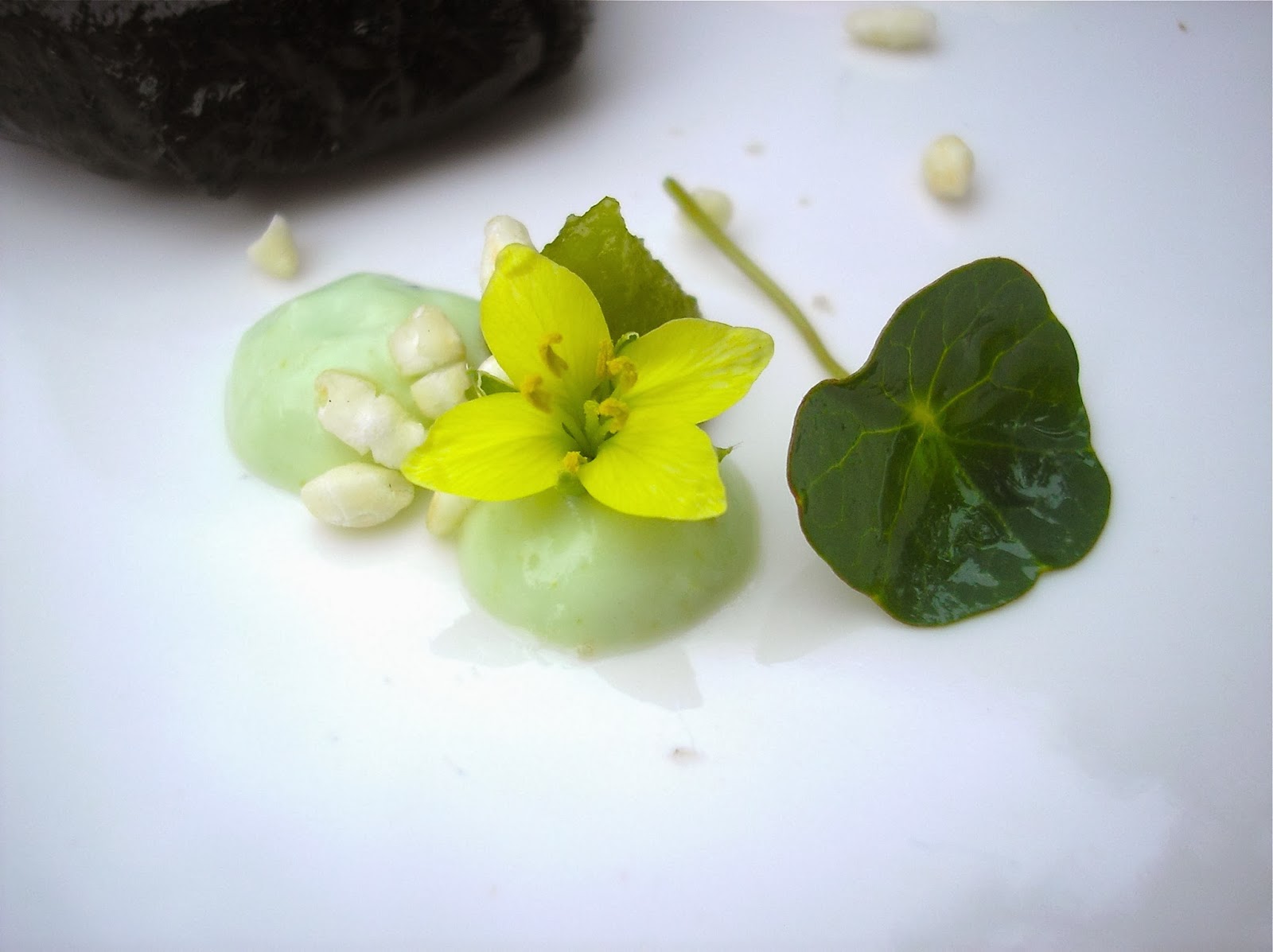
Wild caught Sea Scallops wrapped in Nori seaweed , Edamame bean puree , Wasabi paste , Pickled ginger gel , Puffed sushi rice , Nasturtium leaves and Wild rocket flowers.

              This Japanese inspired dish is full of flavour kick and really showcases this beautiful seafood caught wild from the waters of the USA. Food miles has been blown out the window with this dish but I'm a firm believer of growing and producing what you can locally where possible, with the exception of compromise when it comes to exported superior quality grown products being consumed sparingly and seasonally, any way each to their own on this subject. This dish has textural and flavoursome contrasts with every mouthful and uses these japanese ingredients exceptionally well to bring out the best of the hero of the dish, the American sea scallop. You receive the sweet and sour from the pickled ginger gel, the hot and spicy from the wasabi, crunch from the puffed rice, peppery notes from the nasturtium leaves and saltiness from the nori which is all balanced by the scallop and edamame puree. Edamame beans are immature soybeans which are picked green and often served boiled and salted in their pods as a table snack in Japan.                                                                                                                
               This was a simple dish to put together and takes just a few minutes to cook. I began by making the 'Pickled ginger gel' by placing pickled ginger and a little rice wine vinegar and water in a blender, blending to a puree. This was then strained and poured into a saucepan with 1% agar agar and brought to a simmer whisking to dissolve the agar. Once dissolved I removed the pot from the heat and poured the mixture into a mould and allowed it to set. Once the mixture had set I placed the jelly into a blender with a little water and blended to puree of which I strained through a sieve before spooning into a piping bag and placing in the fridge for later plating. Next I placed some edamame beans in salted boiling water and cooked until tender, these were then placed into the blender with a little cream and seasoning and blended to a puree. The 'edamame bean puree' was then placed into a piping bag and chilled before serving. The 'nasturtium leaves' were from the backyard simply dressed in peanut oil and served as is. The 'wasabi paste' was store bought and came in a tube for easier application. To make the  'puffed sushi rice' I just simply put the sushi rice dry into a hot skillet, tossing them around until they start to puff of which they were then removed from the heat and finished off with the residual heat in the pan. The 'wild rocket flowers' came from my backyard and give off colour and a slight mustard flavour. Just before plating I placed the 'wild caught sea scallops' into a skillet over a hot flame and seared both sides until the scallop begins to loose its translucent appearence and becomes opaque, about 2 minutes both sides. These were then removed from the pan and allowed to rest before wrapping each scallop in a trimmed sheet of the 'nori seaweed', dampening the overlap with water to make it stick down these were then transferred back to the hot skillet to be finished off, about another 1-2 minutes each side. The nori scallops were then seasoned with a little sea salt and some toasted sesame seeds.


Monday, 10 February 2014

' BROCCOLINI & MISO BUTTER .'

Broccolini steamed , Wakame shiro miso butter , Mirin honey , Toasted white sesame seeds , Roasted peanuts & wild rocket flowers.

           Here we have another really simple vegetarian dish with Japanese influence, using fermented ingredients again to give complexity and the unami flavour not able to be achieved with vegetables on its own. Fermented products such as soy and miso can also supply a vegetarian diet with vitamins, minerals, enzymes and good bacteria needed for optimal health. The concept of the miso butter comes from world renown Korean American chef David Chang and goes with almost any vegetable. The mirin honey lends a complete balance of sweet and sour, while the roasted peanuts and toasted sesame seeds give textural contrast and a unique nutty flavour from the oils in the seeds and nuts which pair perfectly with the richness and salty miso butter. I used wakame shiro miso for this dish which is my favourite of the miso pastes with its subtle seaweed flavour. Wakame is an edible sea vegetable which comes from the cold temperate waters of the Japanese coastline and shiro means white, putting it all together you've got wakame shiro miso or  white miso with seaweed. This type of miso paste is usually used in soups or salads but is also perfect for this application.                                                                  
             In making this simple Japanese entremet I started by whipping some miso paste with unsalted butter until soft and homogenised, this was swiped onto the plate using a silicon spatula. The butter can be kept for quite a long time so you can make a bigger batch and keep the remaining in the fridge for later purposes. In a saucepan I put some water on the boil, lowering to a simmer I placed some broccolini florets in to a steamer basket over the simmering water and steamed the broccolini until cooked but still firm, this was then removed and placed into an ice bath to cool before arranging at both ends of the miso on the plate. The mirin honey was made simply by combining the mirin and honey together, this also can be kept for quite some time stored in the pantry in a sealed bottle. I drizzled the mirin honey on both sides of the miso butter. In a hot skillet a toasted off some sesame seeds placing them on top of the broccolini with some wild rocket flowers. And last of all in the same hot skillet I toasted some chopped peanuts placing next to the broccolini to accompany the dish.


Sunday, 9 February 2014

' SWEETCORN & ASPARAGUS SALAD .'

Warm salad of Sweetcorn & Asparagus , Wakame Shiro miso, Sauteed onions , Toasted sesame seeds & Shichimi Togarashi .

                    This is a taste sensation and is simple and quick to make. Essentially a vegan friendly warm salad of sweetcorn and asparagus using the bold flavours of spice and heat with that savoury unami flavour from the fermented miso paste to help add a rich deep element to the otherwise light fare. The dish was seasoned with the japanese chilli spice shichimi togarashi, a spice mix containing seven flavours ( black and white sesame seeds, poppy seeds, roasted orange peel, sancho, ginger and nori). The asparagus in this dish was supplied by friends of ours (Buchanan's produce) and are local to the area, growing the freshest of organic produce and a decent size flock of dorper lambs. Many thanks Warren and co. for the gesture and the ongoing inspiration and knowledge in growing good food.    
                    Together in a bowl I mixed some shiro miso, rice wine vinegar and mirin to a paste before making a swipe on the plate. Standing a cob of corn on its end I cut the kernels of corn from off the cob with a sharp knife. I cut the asparagus into small pieces and sliced a small onion finely. With a little butter I sauteed (sweat) the onions off before removing, turning the heat up and cooking the corn and asparagus. I first laid a bed of sauteed onions across the swipe on the plate before placing the corn kernels on top of the onions followed by the asparagus. I seasoned the plate with some toasted sesame seeds and some Japanese seasoning shichimi togarashi.