Showing posts with label entree. Show all posts

Tuesday, 12 August 2014

' CREAMY PRAWN BISQUE .'

Creamy Prawn Bisque served with Tempura Queensland banana prawn & asparagus spear, Dill and olive oil herb.

                  Inspired by an overload of collected frozen prawn heads and shells in our downstairs freezer and urgent need to free up some space, I decided to put together this full flavoured bisque. A creamy soup from french origin originally, the bisque was said to be a perfect way to use up imperfect crustaceans of which can not be sold at the markets. Traditionally a bisque was made by grinding the crustaceans to form a paste which was then used to thicken a soup stock. Usually served with crusty bread, I decided on swapping the bread for some more decadent offerings to be used for dipping into the bisque, tempura battered Queensland banana prawns and asparagus spears on skewers.
                  To make the bisque, I began by roasting the prawn heads and shells in a roasting dish for about 30 minutes until the shells were rich in orange colour and robust in flavour. In a heavy based saucepan I sauteed shallots, carrot, celery, fennel, garlic, peppercorns, coriander seeds and salt in a little oil. To this I added crushed tomatoes, cayenne pepper, parsley, thyme, bay leaf and the prawn shells. This was cooked down a little before adding some brandy to deglaze the pot. Simmering gently this was reduced before adding some verjus and reducing some more. Once reduced I added some fish stock and simmered for 30 minutes. I then removed the pot from the stove and blended the stock to a puree of which I then strained and returned to the stove. I then simmered the pureed soup for a further 15 minutes until the bisque become rich in copper colour, to this I added some cream to round the flavours out and finish the mouthfeel. To make tempura I simply mixed together some flour and ice cold apple cider to form a batter in which I coated the prawns and asparagus spears lightly before deep frying in 170C oil until light golden colour.


Friday, 8 August 2014

' BLOOD ORANGE SCALLOP CEVICHE .'

Scallops cured in blended citrus juice and arranged with Blood orange supremes, Brunoised vegetables, Preserved lemon, Micro herbs and nori seaweed tile, served in a Blood orange sauce spiked with chilli.


                   I love Scallops cooked his way and when the blood oranges hit the shelves, I had to try this ceviche recipe which uses a blend of juice from citrus fruits, blood orange, limes and lemon together with a splash of verjus, This looks like a lot of prep for 3 scallops but this is surprisingly easy to prepare and there is no cooking involved, in 45 minutes you've got a very tasty seafood entree that looks alright too. Each component has its place and involvement in the end finish of the experience. Have a go at this dish while the oranges are at their juiciest, below is how simple it really is.                                          
                   Here is a list of the preparations in order of method.                                                                    
SCALLOP CEVICHE- In a glass bowl I whisked together 1/4 cup of blood orange juice, 2 tbsp each of lime juice, lemon juice and verjus, pinch of sugar and salt, until the salt and sugar dissolved. I then washed and pat dried the scallops placing them in the bowl of blended juice and covering the bowl with clear film. The bowl was then placed in the fridge and the scallops were allowed to cure for 45 minutes.                                                    
BLOOD ORANGE SAUCE- In the time the scallops are curing I made the the sauce and prepared the finishing accompaniments. To make the sauce I simply whisk together in bowl 1/4 cup of blood orange juice, 1/2 tbsp of each lemon, lime and verjus and olive oil, this was then seasoned and given a splash of tabasco sauce before being placed in the fridge to chill.
FINISHING- To accompany the scallops and finish the dish I prepared a micro brunoise of red radish and celery. Then thinly sliced some watermelon radish, cut a nori sheet into little 1/4 inch square tiles and cut blood oranges into half supremes and preserved lemon rind into little pieces. The final garnishes did not require preparation and consisted of young yellow celery leaves, dill fronds and opal basil blossom.


Tuesday, 13 May 2014

' 53 deg . C . PINK LING in ICHIBAN DASHI .'

53 degree C. sous vide cooked Pink Ling fillet in Ichiban Dashi with Aubergine & wakame miso dumplings, Wakame seaweed and lemon zest.

           This was a little Japanese influenced dish, that uses the dashi and miso dumplings to accompany an otherwise delicately flavoured fillet of fish. Ichiban dashi or 'first sea stock' is the stock collected from two ingredients Kombu, which is a type of kelp and Katsuobushi, dried bonito fish flakes. Once the stock is made a second stock can be made using the same ingredients called 'Niban dashi'. Dashi is economical and extremely easy and quick to make in comparison to other stocks where you have to boil carcasses or roast bones or fry prawn heads, dashi takes just about 30 minutes to make and is highly nutritious. The element of umami, considered one of the five basic favours in Japanese cuisine, is present in dashi by the use of Katsuobushi which contains high levels of sodium inosinate which has been identified as a source of umami.                                                                                                          
         To make this dish I started with roasting a whole eggplant in a 220 degree C. oven for about 20-25 minutes until the skin were roasted and separated from the pulp which was soft. I removed the eggplant from the oven and allowed to cool a little before peeling off the skin. I removed the seeds from the pulp and placed into the blender with some wakame miso and a little water and blended to form a runny puree. This was added to a mix of wheat and buckwheat flour to form a dough. Next I made the dashi by placing three strips of dried kombu kelp with 4 cups of water in a saucepan to soak for 15 minutes. I then place the saucepan on the stove and brought the water and kelp up to just before boiling point before removing from the heat and adding half a cup of bonito flakes scattering over the top. After about 3-4 minutes the katsuobushi had sunk to the bottom, I then strained the stock through a cheese cloth lined strainer and set aside for serving. While the eggplant was roasting a set the sous vide machine to 53 deg. C. and placed a fillet of pink ling with a little crushed ginger and some butter into vacuum sealed plastic pouch and cooked the fish at 53 degree C. for 30 minutes. To serve a placed the spent ingredients from the dashi back into the saucepan with 4 cups of water and brought the water to the boil, simmering for around 10 minutes to form a second sea stock called the Niban dashi. While the dashi was simmering I formed little rounded balls with the dough and once the dashi was ready and strained. The dashi was returned to the simmer and the dumplings were cooked in the dashi for about 2-3 minutes.
      To serve I reheated the ichiban dashi , pouring the dashi into a flat bottom bowl. I then placed the Pink Ling fillet in the centre of the bowl, arranging some seaweed and the dumplings around the fish. I then topped the fish with a little lemon zest.


Wednesday, 7 May 2014

' SCALLOP CEVICHE in CUCUMBER JUICE .'

Ceviche style Wild caught Sea scallop in Persian Cucumber juice with Coconut and ginger sorbet, Baby carrots, Cucumber ribbons, Pork crackle and Fresh Water cress.


                    Ceviche is a Spanish term used for a seafood dish, typically fish which has been cooked using a curing method of citrus juices, rather than heat. This dish is popular to polynesia and central and south America, although the origin is still disputed it probably lies in the area of present day Peru, amongst the Moche, a small coastal civilisation that began to flourish 2000 years ago. It is now documented that the Moche apparently used the fermented juice of the banana passionfruit and recent findings of during the time of the Inca empire a fermented beverage made from quinoa grains called 'chicha' was used to cure fish consumed with salt and aji an Andean chilli. And it is proposed the natives simply switched to citrus juices brought over by the Spanish colonists. Ceviche nowadays is used for a number of different meats and shellfish accompanied by various ingredients. This method of cooking with acid should be practised with only the freshest ingredients and under extreme hygienic care to avoid food poisoning. The end result is well worth the extra attention to cleanliness.                        
                  I started preparing this dish by making the coconut and ginger sorbet. For this I simply placed coconut milk, sugar and sliced ginger into saucepan and heated gently, without boiling. Once the sugar was dissolved the saucepan was then removed from the stove and a lid was placed on and the ginger was allowed to steep in the milk for an hour. I then poured the milk through a sieve and placed into a metal container and allowed to freeze for 6 hours, forking the mix every two hours to break the ice up. Next I placed a piece of scored pork belly skin, salted into a 230 deg. c. oven until the skin turned to a puffy, golden crackle of which I then removed from the oven and set aside. In the mean time I prepared the scallops by slicing thinly, layering them in a bowl.To make the marinade I simply mixed together lime juice, caster sugar, salt, thinly sliced shallot and a little olive oil. This was poured over the scallops and allowed to marinate in the fridge for 20 minutes. During this time I juiced a persian cucumber with a little seasoning before straining through a sieve and set aside in the fridge to chill before serving. I then prepared the vegetables slicing thin ribbons of cucumber with a vegetable peeler and thin slices of baby carrots. Both these then dressed with a little olive oil. The water cress was harvested from the backyard and simply washed and dressed with oil also.                                                    
                 To plate this dish I layered the ceviche at the bottom of a shallow soup bowl placing a quenelle of sorbet on top before carefully arranging the vegetables and crackle around the scallops and pouring a little amount of the chilled cucumber juice to fill the bottom of the bowl.


Friday, 11 April 2014

' 53 deg . C . LAMB SOUVLAKI in GRAPE LEAF .'

53 degree C. Sous vide cooked Tassie Royal Lamb Souvlaki in Grapevine Leaf served with Minted Greek yoghurt , Preserved lemon , Salted capers , Black garlic paste , Fried parsley and fresh oregano.


                  During the week I visited my favourite independent grocers 'food fantasy' after work. I love going to this humble little food hub and its been a few weeks now that I had paid a visit to the store. A different delicacies were on offer, I picked up a pack of brined grapevine leaves ( good,big,green ) about a dozen in total for $2.20 AUS. While I was in the store foraging I came across fresh Kalamata olives and when I asked one of the staff what was involved in the prep of the olives, he went out the back and got the little old Italian lady. Familiar with my face she talked me through the four week process of brining the olives while hand selecting me a half kilo into a bag that I'd requested. The olives were $6 a kg. costing me $3 AUS. for my Kalamata olives. So I guess the trip to the 'food fantasy' and the butchers for the quality piece of free ranging grass-fed lamb from greener pastures of Tasmania have been the inspirations of this Mediterranean flavoured cuisine.                                                          
                 This was a very simple dish to make I began by marinating the lamb overnight in the fridge in a vacuum sealed pouch containing butter, dried oregano, smoked paprika, dried thyme, salt, white pepper, a pinch of cumin and a little garlic paste. The next day I set the sous vide machine to a water bath temperature of 53 degrees C. and cooked the pouch of souvlaki marinated lamb for one hour. during this time I prepped the accompaniments firstly the minted yoghurt was a mixture of greek yoghurt, fresh mint from the garden finely chopped, a little garlic paste, drizzle of olive oil and a squeeze of lime juice before being lightly seasoned with salt. To make the black garlic paste I simply blended black garlic with a little olive oil to form a puree. The preserved lemons was an earlier prep, I mean way earlier, like this time last year or earlier. These are simply preserved over time in jars packed with salt and filled with lemon syrup. Over the time the skins soften and the pulp turns to the preserving liquor it is the skins that are scraped back and rinsed before being added whole or diced into dishes to give an up lifting citrus element to the dish. The capers were store bought but have been drained and mixed with himalayan pint salt in a container in the fridge for a number of months now. Once the lamb was ready I removed the lamb from the pouch and straight into a hot pan with the juices of the pouch poured over the lamb while it quickly seared on both sides of the fillet. Once the outside of the meats proteins had caramelised I removed the fillet from the pan placing it straight at the bottom of a spread brined grapevine leaf on a cutting board. The lamb was then rolled in the leaf and returned to a hot pan with a little olive oil to cook the outsides of the leaf, while this was cooking a placed some sprigs of parsley in the hot oil to crisp up. Both the parsley sprigs and the rolled lamb were removed once cooked and left to rest for 3-4 minutes. The parsley was then seasoned with smoked cypress sea salt.                  
                I presented this plate by making a series of random swipes with the minted greek yoghurt. I then sliced the grapevine leaf wrapped souvlaki lamb in to various widths and strategically arranged them around the plate displaying the beautiful perfectly evenly cooked lamb contrasted by the dark green vine leaf. I then added the accompaniments of salted capers, preserved lemons, black garlic paste, the crunchy fried parsley and to finish the dish fresh micro oregano leaves from the garden.


Saturday, 5 April 2014

' plated CHICKEN , PEA & NOODLE SOUP .'

Plated Free range chicken broth , Garden pea caviar , Fresh egg noodles , Shredded chicken breast , pea flower greens.


                     Its the beginning of mid autumn here and you wouldn't think so weather wise, with only the night temperatures dropping ever so slightly, the humidity is still high and the day temps are in the high 20's pushing 30. The peas in my garden have shot up and we're starting to get our first pods and the snow peas are in prolific flower, great signs of a good crop. This dish was inspired by the garden harvests and with a left over chicken frame in the freezer I decided to serve up a plated soup. To add a little twist I turned the broth into a thickened sauce and made pea caviar using the 'cold oil spherefication' technique form pureed garden peas.                                                                                        
                      To make the chicken broth sauce I began by placing in a large stock pot a frame from a free range chicken, caramelised onion halves, chicken breast fillets, chopped carrots, celery, parsley, bay leaf and seasoning, covering with water I brought the stock to the boil reducing to a simmer for 2 and a bit hours. This was then strained and the breast fillets were put aside for shredding, some of the broth was reserved to make the sauce and the rest was placed into a small sauce pan with some fresh garden peas and brought to the boil. Once the peas were cooked they were placed into a blender with a little of the cooking stock and blended to a puree, this was then stained and set aside. I then placed a tall glass of canola oil in the freezer allowing the oil to chill and thicken for about half an hour. In a small saucepan I put the strained pea puree and 1% agar agar heating to a simmer while whisking to dissolve the agar powder, this was then removed and allowed to cool to 60 deg. c before I removed the oil from the freezer and prepared to make the pea caviar. With a syringe I drew up the pea liquid and slowly drop droplets of the liquid into the cold oil, as they slowly sunk to the bottom of the glass they had time to set solid. Once a dropped all the liquid I strained the the glass of oil, collecting the oil in a jar for later applications and trapping the caviar in the strainer, these were then rinsed and set aside for plating. In a bowl I combined flour and eggs and made a simple dough, kneading for 5-10 minutes. After chilling the dough for half an hour I rolled the dough out on a floured surface before passing through the rollers of the pasta machine, this was then run through the spaghetti attachment and dusted with flour to keep the strands separated. In a large pot of rolling salted boiling water I cooked the noodles for 2 minutes before removing and placing under cold water to stop the cooking process. To finish the sauce I placed the reserved chicken broth in a small saucepan bringing to broth to a simmer, with a little of the heated broth I added some arrowroot flour and made a paste before adding back into the broth and whisking to incorporate. Once the sauce had thickened I removed the pot from the heat ready for plating.                      
                   To plate I began by spooning some of the chicken broth sauce in the centre of the plate. I then arranged the shredded chicken breast, pea caviar and egg noodles on top of the broth. Garnishing the plate with droplets of broth with pea caviar, pea greens and topped with a pea flower.                    


Sunday, 30 March 2014

' BRAISED LEEK with OYSTER MUSHROOM .'

Oven braised Leeks with Sugar-cane raised Brown oyster mushrooms , Wild rocket , Green apple & chilli jelly and Miso & maple foam.

                      This little taster dish is a perfect way to showcase some of the mushrooms coming to harvest of late. My mycology set up is outdoors and has very little climate control so having said that the mushroom season for me is between now and late october, outside of these dates the temperatures
are just too high and not ideal for growing. I grow mainly oyster mushrooms (of all colours) and I have
some log cultured shitake that are half way too fruiting. The oysters I grow are raised on pasteurised sugar-cane mulch and are grown in bags, ziplock bags and in buckets. My method of using inoculated dowel spawn has been a success but this season over winter I will be trying grain spawn poplar wood boards and recycled paperback books to mix things up a bit. It will be interesting what the different growing mediums will have to the overall taste of the final product. I think the sugar-cane fed mushrooms have a slight grassier taste to store bought oysters which I find are quite bland in taste. Leeks are also in season right now but for this dish I used store bought leeks. The wild rocket has been
a perpetual patch in my garden for 2 years now, going to seed and the seedlings keep popping up giving me an all year round harvest of the mustard flavoured green leafy and not to mention those little
mustard flavoured flowers I often include in my dishes. This plate is packed with flavours from the sweet flavours from the braised leeks to the spice of the chilli to the earthy and grassy flavours of the cane fed oyster mushrooms and the Unami flavours of the miso in the foam. This also makes for a great little vegan option for an entree.
                          I started by chopping the leeks into 1 inch thick pieces and placing them into a roasting pan. I then added some vegetable stock to come to the top of the leeks but not covering them, to this
I drizzled a little sesame seed oil, seasoned and covered the pan with foil before placing into a 160 deg. c. oven and braising for an hour until soft and sweet. In a saucepan I placed chopped green apples and some green chillies with half water, half cider. This was brought to the boil and reduced to  simmer for around half an hour until the apples were pulpy. I then poured the pulp into a cloth bag and allowed to filter for around 2 hours,collecting the juice. I then added the juice to a clean saucepan adding sugar, allowing 500g for every 500ml of juice and a little lemon juice. This was brought to the boil for about 10 minutes before being poured into hot sterilised jars and sealed for later use. I then sauteed the mushrooms in a little unsalted butter and seasoned them with salt and cracked pepper. Just before plating I placed some rice wine vinegar, white miso paste, maple syrup, soy sauce and soy lecithin into a tumbler and using a stick blender I formed bubbles. The excess liquid was poured off leaving just the foam which was kept in the fridge until ready to use.                                                                                    
                            To plate I spooned a little half set apple, chilli jelly in the middle of the plate arranging the braised leeks on top accompanied by the sauteed oyster mushrooms. I then spooned the foam over the dish and garnished the plate with some wild rocket and cracked black pepper.


Friday, 14 March 2014

' tea smoked SEA SCALLOP with WAKAME SALAD .'

Tea smoked Wild caught Sea Scallop with Wakame salad , Compressed Asian pear & sake , Pickled Baby Bitter melon , Water cress , Black garlic puree & wild rocket flowers .

                     With this dish I've used some Asian inspired ingredients to lift and accompany this succulent wild caught off the coastlines of the US sea scallop. I chose to cold smoke the mollusc using a tea smoking boat with the scallop on a rack over a bowl of ice to keep the temps down. Bitter melon plants went in late for me this year and are just coming on now with my 3 vines producing plenty. When small these melons are very concentrated and bitter but when pickled with vinegar, sugar and salt, this mellows and almost tastes like a cross between gherkins and capers.
                     To make this dish I first started with the compressed nashi fruit, for this technique I used the vacuum food saver sealer . Cutting the pear into brunoise, I placed them in a bowl and covered them with sake. After 5 or so minutes I drained the diced pear and placed them and a little frozen pear juice in to a food grade plastic pouch and vacuum sealed twice. This was left to compress and burst the cell walls of the fruit and release extra flavour while marinating in the sake, for about half an hour or so. In the mean time I made the wakame salad by simply mixing in a bowl wakame seaweed, sesame seeds, sesame oil, rice wine vinegar, sake, chilli flakes and a little salt this was then chilled until plating. To pickle the bitter melons I placed equal parts of water and rice wine vinegar, enough to cover the melons in a saucepan on a medium heat together with some sugar and salt. This was brought to a slow simmer for about 15 minutes until the melons were soft and tender to touch. I then drained them before plunging into an ice water bath to stop the cooking process, these were then drained and chilled for serving. After the half an hour was up I removed the asian pear pieces from the vacuum packaging, rinsed them quickly under cold water and dressed them in olive oil and black sea salt. The black garlic puree is just simply mashed black garlic piped through a plunger. The final component was the sea scallop of which I first seared very quickly on a hot skillet before rubbing in salt and brown sugar. In a foil boat I placed a mixture of some jasmine rice, jasmine tea leaves, brown sugar, black pepper corns and orange peel zest. This was placed into the smoker and was the vessel was filled and the boat was smouldering, I turned the flame off waited a little and with the scallop on a rack above a bowl of ice, I placed the bowl in to the smoker and cold smoked the scallop until fully cooked before removing from the smoker ready for plating.
            To plate I placed the smoked scallop on top of a bed of home grown water cress, this was topped with some wakame salad, a little black garlic puree, micro bitter melon and an edible wild rocket flower. I arranged the compressed asian pear pieces, wakame salad and pickled bitter melon with the black garlic puree and edible flowers to accompany.


Sunday, 23 February 2014

' NORI WILD CAUGHT SCALLOPS .'

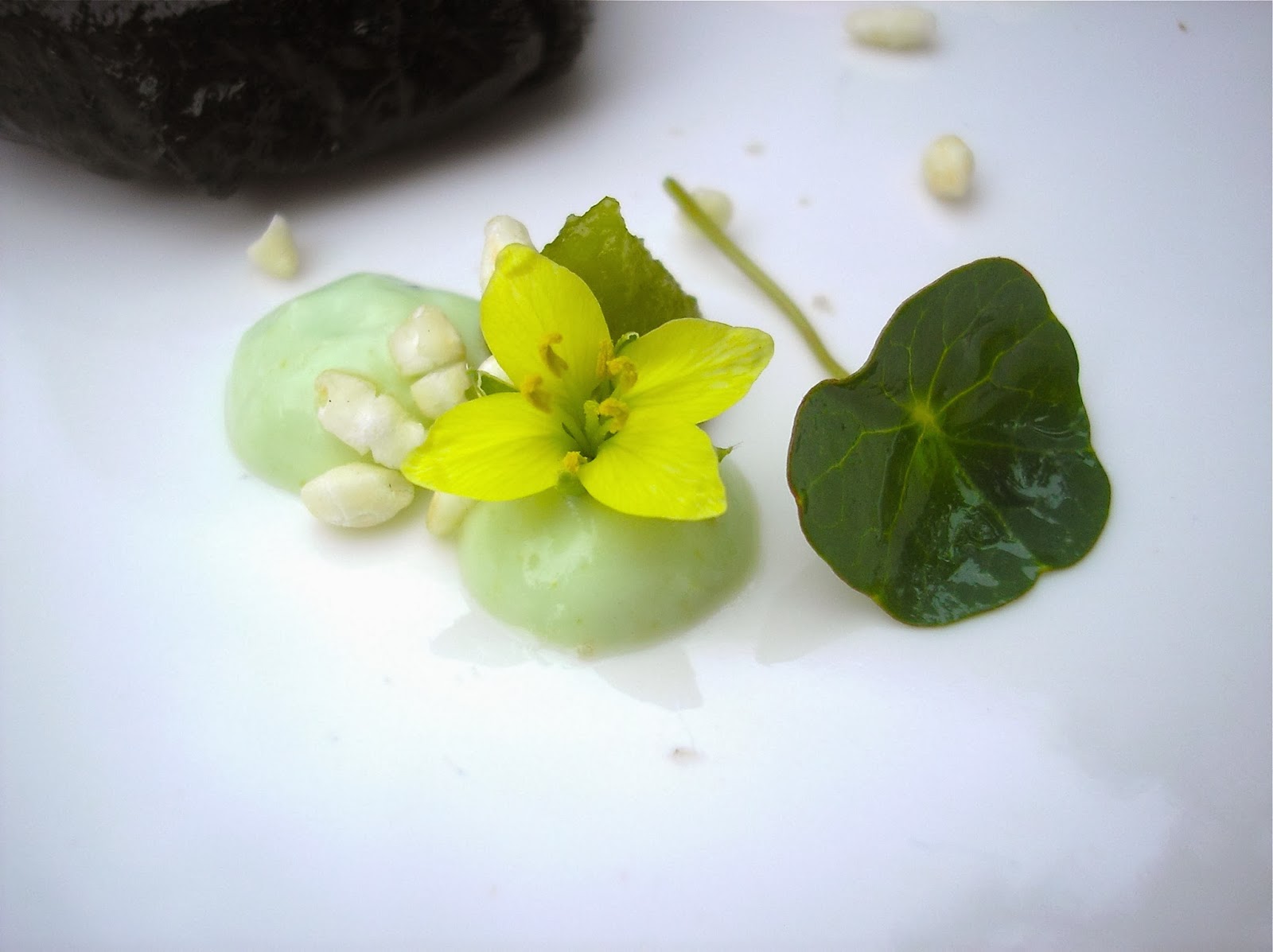
Wild caught Sea Scallops wrapped in Nori seaweed , Edamame bean puree , Wasabi paste , Pickled ginger gel , Puffed sushi rice , Nasturtium leaves and Wild rocket flowers.

              This Japanese inspired dish is full of flavour kick and really showcases this beautiful seafood caught wild from the waters of the USA. Food miles has been blown out the window with this dish but I'm a firm believer of growing and producing what you can locally where possible, with the exception of compromise when it comes to exported superior quality grown products being consumed sparingly and seasonally, any way each to their own on this subject. This dish has textural and flavoursome contrasts with every mouthful and uses these japanese ingredients exceptionally well to bring out the best of the hero of the dish, the American sea scallop. You receive the sweet and sour from the pickled ginger gel, the hot and spicy from the wasabi, crunch from the puffed rice, peppery notes from the nasturtium leaves and saltiness from the nori which is all balanced by the scallop and edamame puree. Edamame beans are immature soybeans which are picked green and often served boiled and salted in their pods as a table snack in Japan.                                                                                                                
               This was a simple dish to put together and takes just a few minutes to cook. I began by making the 'Pickled ginger gel' by placing pickled ginger and a little rice wine vinegar and water in a blender, blending to a puree. This was then strained and poured into a saucepan with 1% agar agar and brought to a simmer whisking to dissolve the agar. Once dissolved I removed the pot from the heat and poured the mixture into a mould and allowed it to set. Once the mixture had set I placed the jelly into a blender with a little water and blended to puree of which I strained through a sieve before spooning into a piping bag and placing in the fridge for later plating. Next I placed some edamame beans in salted boiling water and cooked until tender, these were then placed into the blender with a little cream and seasoning and blended to a puree. The 'edamame bean puree' was then placed into a piping bag and chilled before serving. The 'nasturtium leaves' were from the backyard simply dressed in peanut oil and served as is. The 'wasabi paste' was store bought and came in a tube for easier application. To make the  'puffed sushi rice' I just simply put the sushi rice dry into a hot skillet, tossing them around until they start to puff of which they were then removed from the heat and finished off with the residual heat in the pan. The 'wild rocket flowers' came from my backyard and give off colour and a slight mustard flavour. Just before plating I placed the 'wild caught sea scallops' into a skillet over a hot flame and seared both sides until the scallop begins to loose its translucent appearence and becomes opaque, about 2 minutes both sides. These were then removed from the pan and allowed to rest before wrapping each scallop in a trimmed sheet of the 'nori seaweed', dampening the overlap with water to make it stick down these were then transferred back to the hot skillet to be finished off, about another 1-2 minutes each side. The nori scallops were then seasoned with a little sea salt and some toasted sesame seeds.


Friday, 21 February 2014

' FRIJOLES NEGROS with CORNBREAD .'

Cornbread with Black Turtle beans Smoked chipotle salsa , Mexican-style chorizo , White maize kernels , Lime , Guajillo chilli , Tomatillo salsa verde , Sour cream , Queso fresco and pea shoots.

                In the heat of the summer I always enjoy my mexican food, weather its cobs of corn charred on a hot grill plate, generous butter and smoked salt or Fajitas done on the barbecue, the pairing of mexican and summer are perfect. Cornbread was the inspiration and hero of the dish here and to this I added nine other components to accompany the beautifully sweet starch. Below I've made a list of the preparations in some kind of order and by their titles.                                                                                  
   cornbread - I made the cornbread by sifting all purpose flour, cornmeal, baking powder, salt and sugar into a large bowl. In a separate bowl I beat eggs, milk, and melted butter and to this I gradually added the flour mix beating to form a batter. I then poured the batter into a lined loaf tin placing into a 180 deg.c. oven and bake the bread for 25 minutes before removing, de-panning and set aside to be cooled on a wire rack before being torn apart to be plated.                                                                            
  queso fresco - This is a soft curd cheese made from coagulating cows milk with white vinegar, the result is similar to ricotta but with a sharper taste and more bleached curd. To make the queso fresco I heated some cows milk in a saucepan until just before boiling point, to which I then added a little white vinegar and removed from the heat stirring to separate the curds. I then ladled the curd from the whey and strained through some cheese cloth, the cloth corners were then gathered and the curd was hung in the fridge to drain excess whey before being crumbled for plating.                                                          
  chorizo - To make this meat mix I simple placed onion, garlic, jalpeno peppers, oregano, cumin, thyme, and a little oil in a food processor blender to make a paste. To this I added pork mince and mixed to incorporate, the meat was then fried off in a hot pan before being set aside for plating.                  
  tomatillo salsa - Into a saucepan I placed tomatillos, onion, garlic, green chillies, lemon juice, cumin, coriander, salt and a little white vinegar. To this I added water and brought to the boil before reducing to a simmer and cooking the tomatillos until soft about 10-15 minutes. The salsa was then poured into a blender and pureed to a green salsa verde sauce.                                                                                          
  turtle beans - These were soaked overnight before this preparation and then placed into a saucepan with a little olive oil, smoked paprika, onion and a bay leaf and sauteed before being covered with water and simmered for around 40 minutes. Once cooked they were drained and set aside to be plated.      
 smoked chipotle salsa - Using some of the cooked beans I added them and some onion, tomato, smokey dried chipotle peppers, green chillies, salt,vinegar, sugar, garlic paste, lemon juice and some smoked paprika into a saucepan with a little water bring to the simmer before removing to cool.                
 white maize - I simply cut the kernels from the cob using a sharp knife, dressing the kernels in a light coating of olive oil and lime juice I pan fried them in a hot skillet until just showing colour before I removed them from the heat and allowed them to cool for serving.                                                              
 guajillo chillies - These were simply sliced thinly, the sour cream and pea shoots were store bought.