Showing posts with label bush foods. Show all posts

Friday, 8 August 2014

' TWO LOCAL PRAWNS IN A BARK BOAT .'


 Local bay prawns in a Native lime berry, Chilli & Ginger sauce, aboard a Paperbark boat, served with Barley couscous and Captain Cooks spinach. 

                    This dish showcases some of the great indigenous foods we have been blessed with in our great country. Most of these indigenous bush-foods can only be found here too, making them a rare and cherished experience for me. In this little appetiser I use some fresh local bay prawns and marinate them in a marinade made of home grown native lime berries with chilli and ginger. These are cooked on the barbecue and served on a bed of barley couscous, which has been cooked in the liquor from steamed pipi's. And accompanied by some homegrown native spinach. The canoe was crafted from a trimmed sheet of bark from the paperbark tree in the front yard and made in similar fashion to the bark boats our indigenous people use for transport and to fish from. The boat was folded, pinned at both ends then soaked in water, before being moulded to shape and cured on a hotplate grill and set aside to harden.                                                  
                    I made the marinade by simmering Native lime berries, lime juice, caster sugar, salt pepper, red chilli paste, ginger paste and crushed garlic until reduced and slightly thickened. I then used a little of the sauce to form a paste with some corn starch and returned the paste to the sauce, stirring until the marinade thickens. I then removed the marinade placing in the fridge to chill before coating the green local peeled and deveined prawns and allowing to marinate in the fridge for an hour with half of the marinade and the remaining was set aside to be used as a plating sauce. The prawns were then cooked quickly on a hotplate basting with the sauce, once cooked they were placed two in a boat to be served. In a saucepan I placed a handful of pipis, some fresh thyme and chopped onions and steamed the pipis in a dry white wine. Once the shells were open I strained the cooking liquor and used the stock to cook the couscous. To finish I blanched the captain cooks spinach in pot of salted boiling water for 2-3 minutes before removing and steeping into an ice bath to retard the cooking process, the blanching removes most of the unwanted oxalic acid which gives native spinach a hairy mouthfeel if eaten raw, similar to the unripe bananas.                                                                                                                          


Thursday, 26 June 2014

' MOUNTAIN PEPPER & WATTLE SEED DAMPER .'

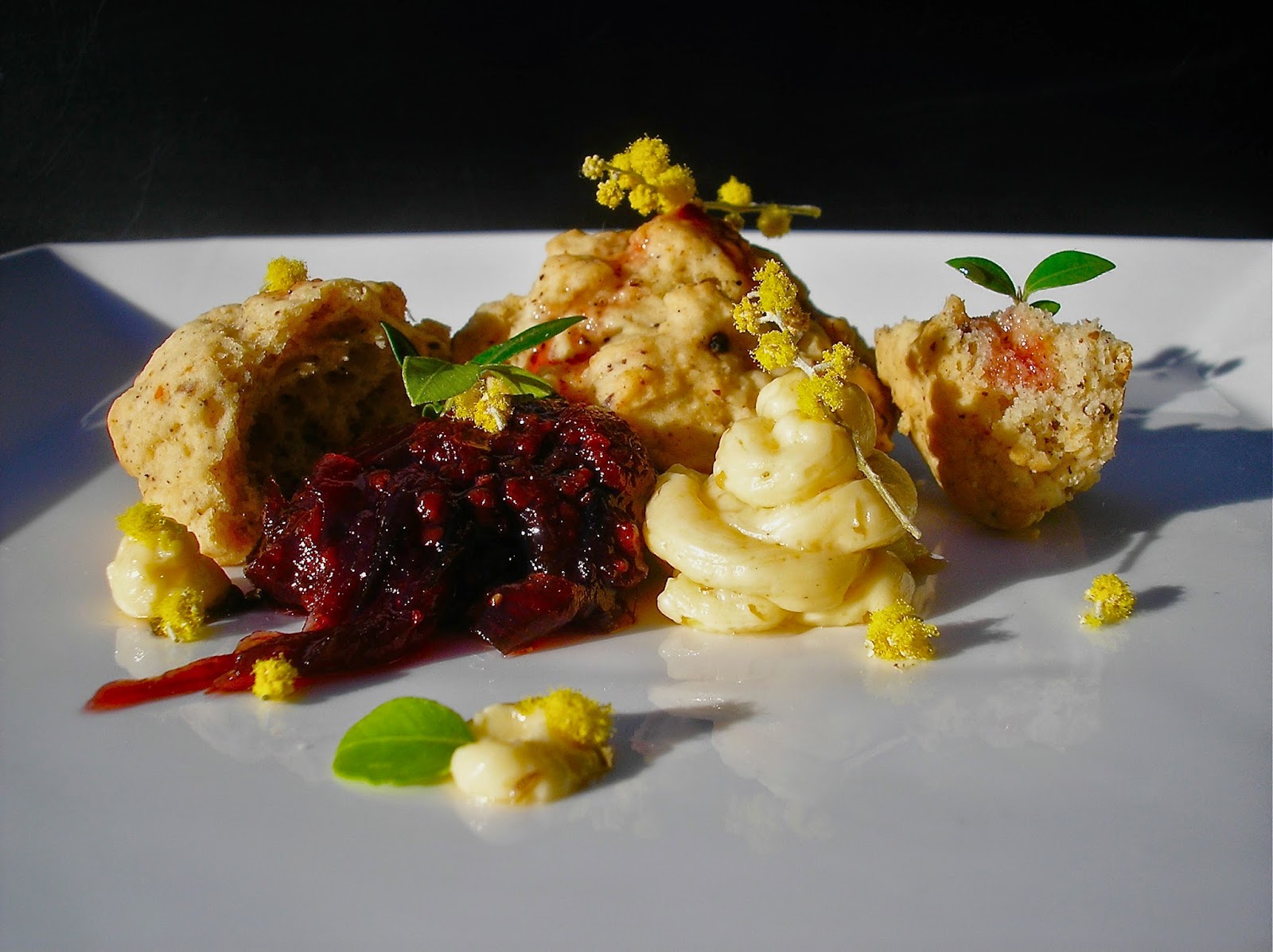
Mountain Pepper & Wild Green Wattle seed Damper with Wattle seed butter, Rainforest fruit jam, Micro Cinnamon & Lemon myrtle leaves and Silver Wattle flowers.


                This little dish, most likely served for afternoon tea is a bit of, when bush tucker meets devonshire tea. Inspired by a little field trip with my two sons in the wetland catchment adjacent to our property. The area is a natural haven for all different water bird, heath and native trees and shrubs and on the fringes wattles and pine. On the walk we managed to forage a 2 litre bucket full of wattle seed from a Green wattle tree and some branches of Queensland Silver wattle bloom, along with some pine needles for a different prep. There are 120 edible Australian acacias, and are being used by the indigenous people of Australia in many ways. Common varieties for seed for this area are the Green, Brisbane, Silver, Cootamundra, and the Velvet wattles. Seed was traditionally eaten either green ( and cooked ) or dried, roasted and pound to a flour to make a kind of bush bread, the damper. The flowers were mixed into a batter and a kind of pancake were cooked on hot rocks and an adhesive was made from the gum (sap) that runs from the trees trunks, in modern bush food cooking this can be used in substitute for other gums, to thicken sauces and set jams, imparting a resinous botanical undertone. Wattle seed when roasted has a nutty malt flavour with a hint of carob. I've used the wild harvested Green wattle seed in making both the damper and the butter. The mountain pepper berry is store bought and comes from Tasmania where it flourishes in the cool mountain climate and the Rainforest jam refers to the native fruits gathered from our backyard food forest. This jam was made about 6 months ago and is a perfect time to make it to the plate. Below are a list of the preps in order of execution.                                            
               In our food forest we have planted out 18 species of bush food plants and there were another 4 species already existing when we arrived at the property. Six species of the ones planted have not survived, leaving us with 16 different bush foods growing through our yard of which 10 of these were used to make the rainforest fruit jam.                                                                                                    
RAINFOREST FRUIT JAM- To make this jam I first made two cups of strong tea from crushed Cinnamon and Lemon Myrtle leaves, this was then strained into a heavy based saucepan to this I added a squeeze of half a lemon and the green seed pods from the rosella fruits. This was brought to a simmer and cooked down for around 10-15 minutes to release and activate the pectins in the pods. Once thickened, the syrupy liquid was strained and returned to the saucepan adding all the prepared fruit ( Rosella calyxes, Midgen berries, Magenta cherry, Lilly Pillies, Sandpaper figs, Native lime berries, Cedar bay cherries and Atherton raspberries). The fruit was cooked down until soft and then measured, adding an equal portion of sugar and returning to the stove to simmer until the jam set on a cold plate.                                
MOUNTAIN PEPPER & WATTLE SEED DAMPER- To make this edible acacia bush bread I began by preparing the wattle seed flour by de-podding the seeds and roasting them for around 10 minutes on a flat tray in a 210 degree C. oven, frequently tossing them around to get an even roast. The seeds were then cooled and ground to a flour in a spice grinder. I also ground some whole pepper berries to a cracked pepper consistency. Then in a mixing bowl I rubbed 60g of softened butter through 3 cups of self raising flour to form a crumb. To this I added 30g of roasted wattle seed flour, a teaspoon of salt and 10g of ground mountain pepper, this was mixed through the crumb to evenly disperse. I then made a well in the centre gradually adding 1 cup of Oat milk mixing to form a dough. The dough was then divided into large spoonful portions and baked in a 200 degree C. oven for around 20 minutes, until golden on top and cooked in the middle.                                                                                                        
WATTLE SEED BUTTER- While the mini bush breads were baking I soaked 2 teaspoons of roasted wattle seed flour, 2 teaspoons of raw sugar, half teaspoon of vanilla extract in a quarter cup of boiling water for 30 minutes, this was then poured through a sieve and set aside. In a small bowl I creamed a half cup of softened butter using a stick blender until soft and fluffy. To this I added the concentrated wattle seed essence and with the stick blender mixed until thick and incorporated. This wattle seed butter can be kept for a month covered and refrigerated.


Sunday, 19 January 2014

' BUSH BEER SNACKS .'

Summer Beer platter of - Spicy Crocodile jerky , Bush tomato & Dorrego pepper leaf flavoured Wild yam chips , Sugar-bag honey roasted Macadamia nuts . 

            The follow on from the popular bush tapas this is a platter to have when having a beer on a summers day (possibly Australia Day) before a barbecue or while watching the cricket. The macadamia nuts were the real inspiration for this dish and the story goes like this. The other day coming home from the local shop on the bikes with the boys we stopped out the front of this house as I wanted to grab some fallen nuts from this big mature macadamia tree. Just as I'm filling my pockets a ladies head pops up from behind a garden bed and says 'take as many as you like, they're messy things'. She walks off inside and not half a minute later she comes back outside and hands me a bag and walks off again. So I quickly grab whats there and get back on the bike, this is 'zero food miles' at its best. The recipe I used for the croc jerky is a traditional Cambodian recipe for marinated sun-dried snake, of which I've just simply replaced the snake for crocodile meat and opted for an oven instead of my solar de-hydrater.          
           To make these bush snacks I first started with slicing the crocodile tail meat while still half thawed thinly, placing the strips into a bowl and mixing with crushed chilli, coriander seeds and roots, crushed black pepper corns and lemongrass, brown sugar and soy seasoning (maggi). This was allowed to marinate in the fridge for 2 hours before placing on to a wire rack and dried in a 50 deg.c. oven for about 4-5  hours. The wild yam chips were made by thinly slicing the yam and soaking in cold water for an hour. The slices were then pat dried and brushed with olive oil before being placed on to a baking paper lined flat tray and oven baked at 170 deg.c until just starting to show colour. They were then removed and seasoned with ground bush tomato and dorrego pepper leaf. The macadamia nuts were shelled and rolled in sugarbag honey before being placed on to a lined tray, sprinkled with salt and roast at 150 deg.c. until golden in colour, removed and allowed to cool.                                                                            
            The centre piece of this dish although edible is there more for its decorative value. Made from squid ink the gelee circle in the middle of the plate holds a chilli bush tomato sauce (red), a honey mustard sauce (yellow) and soured cream (white). These were arranged on to the gelee of squid ink using an indigenous art technique of dot painting. This centre piece has no significance other than the peoples association and perception of the decoration to help identify the culture of the food.


Friday, 20 December 2013

' 16 FRUIT MEDLEY .' #2


Sixteen fruits all individually prepared in a modernist take on a fruit platter.

         This is the second in the 16 fruit series this time a modernist take on a fruit platter with all fruits individually prepared. Like the first in the series some of these fruits have been backyard harvested
(magenta cherry, passionfruit, rosella, green papaya, native raspberry and the cedar bay cherry). Below is a list of the fruits used and their preparations beginning with the rosella calyx at twelve o'clock and working in a clockwise direction.                                                                                                                                  
     Native Rosella calyx (1) - two calyxes, one calyx inside the other.
     Tahitian Lime (2) - topped with black grape slice and salt, piggy backing Native Raspberry (3).
     Dried Fig (4) - poached in shiraz, thyme and sugar topped with cinnamon myrtle leaf.
     Kiwi Fruit (5) - cut with melon baller topped with cinnamon myrtle flower.
     Passionfruit (6) - passionfruit panna cotta topped with vanilla cream, passionfruit pulp & mint leaves.
     Black Grape (7) - black grape topped with grape slice & piggy backing Native Magenta Cherry (8).
     Pink Grapefruit (9) - topped with grapefruit zest and curry herb.
     Banana (10) - banana brulee.
     Jackfruit (11) - topped with mint leaf and cypress black sea salt.
     Black Plum (12) - diced and presented stacked.
     Granny Smith Apple (13) - cube seasoned with black salt & piggy backing Cedar Bay Cherry (14).
     Green Papaya (15) - centre piece : slice of green papaya topped with diced ripe papaya & tarragon.
     Strawberry (16) - gelee made from strawberry coulis, used as the base of the platter.
All fruits were tossed in olive oil, lime juice, pink Himalayan salt and palm sugar before being plated.