Showing posts with label entremet. Show all posts

Tuesday, 8 July 2014

' BLACK - SEA OLIVES .'

 Baby Octopus heads cooked in a mixture of mirepoix & squid ink and marinated in olive brine served with Extra Virgin  cold-pressed Olive oil, Red chilli paste and micro Oregano leaves.  


                 This Mediterranean inspired hors d'oeuvre was a clever use of a by-product to another dish. So if you haven't guessed it by now, you are looking at baby octopus heads that look like olives and not black olives stuffed with octopus. I was experimenting with a Japanese dish that only required the tentacles of the octopuses and was left with the severed heads, when I remembered I had archived a recipe I'd seen for olive brined octopus heads about 4 or 5 years ago. These brined heads are absolutely divine for someone that enjoys seafood and mediterranean flavours. If you like marinated octopus are baby octopus grilled on the barbecue then this is a must try as it takes the ordinary marinated octopus for a ride, its fantastic with crusty bread rubbed with a clove of garlic or just on their own with the accompaniments of a good olive oil, some chilli paste and fresh oregano. I think next time that I purchase baby octopus I will be looking for a recipe to make something with the tentacles which will become the by-product of the heads used for this dish. The recipe below has been scaled for about 12-15 octopus heads and could quite possible do enough for 30-35 heads.
                 To make the olive brined black octopus heads was a journey of anticipation the whole time, beginning with placing the washed severed octopus heads into a small saucepan together with mirepoix sauteed in butter which are aromatics, a combination of diced celery (1 stick), carrot (1 small) and onion (1 small) . I also added 1 bay leaf, sprigs of fresh thyme, a piece of orange peel zest, salt, pepper, enough water to cover the heads, which for me was 1 metric cup and 1 tbsp of squid ink. This was simmered gently on a low heat for an hour covered. While this was happening my mouth was salivating from the smell in the air and after an hour I was ready to just make pasta and run the octopus and its sauce through the pasta and just eat them then and their. I strained the contents of the saucepan, discarding the solids except for reserving the now shrunken octopus heads and returning the strained liquid back to the stove and reduced the liquid down to a syrupy consistency of about 2-3 tablespoons in quantity. I returned the heads back to the saucepan of reduced liquid to coat them in the sauce, this was then allowed to cool completely. Then in a sterilised jar with fitting lid a scraped the heads and the contents of the saucepan and poured in enough olive brine from brined olives to cover the heads, about 1/2 a cup. I then screwed the lid of the jar on tight before shaking the contents and placing in the fridge to marinate for 24 hours, shaking every 6-8 hours to mix the squid ink which tends to sink to the bottom. A day latter the heads had blackened a bit, but to get the black shiny look I coated the heads in a mixture of olive oil, lemon juice and warmed squid ink just before serving. The oregano was from the garden and is a white greek variety, the chilli paste is just that red chillies pureed to a paste.


Monday, 30 June 2014

' PUMPERNICKEL - Imbisse drie Wege .'

Pumpernickel - Snacks three ways. (Toast with Cod liver, horseradish, cucumber, red lumpfish caviar & fennel frond.) (Ravioli filled with Pork brawn served with whole seed mustard, sauerkraut, pea greens & pickled cucumber sauce.) (Sauce served with pulled pork bundle, stewed apple & sage leaves.)


                   Pumpernickel bread has a strong childhood nostalgia with me as there was pumpernickel in our house every that I can think of growing up. Pumpernickel was dads thing and he had it for lunch every day of the week with good butter, cheese and various cold cuts like salami, mortadella, brawn or bloodwurst. I used try it a bit with cheese and salami but for kids in the 80's you can't go past a slice of white vienna instead. It wasn't until later in life that I acquired the developed taste receptors for the complexity of the malty dark rye used in the making of pumpernickel. If beer were white vienna then pumpernickel would be the stout. For this exercise I wanted to capture that essential pumpernickel flavour and present its base in different preparations that are not normally associated with the flavour of pumpernickel for example pumpernickel pasta or pumpernickel sauce.                                                    
                     Below are a detailed description of the three different preparations and the methods I used in making the various snacks you see above.                                                                                            
PUMPERNICKEL TOAST- ( Cod liver, horseradish, cucumber, red caviar & fennel frond.)
This was a very simple no fuss presentation, also the one presented to start the diner off allowing them to capture the pumpernickel in its pure form, only toasted to enhance the flavour. On top of squares I cut from thinly sliced pumpernickel and toasted, I placed a spoonful of minced horseradish. The next ingredient has come under critics eyes over the last decade or so and thats cod liver and the famous cure all colds and flu of the past cod liver oil which is now manufactured by farming an algae which produces the essential beneficial part of cod liver oil, the omega oils that the body can't produce. There are claims to waters being polluted where cod are being harvested therefore poisoning the livers and ours. Back to the liver itself it took me a while to get my head around trying one as I also vividly remember the taste of cod liver oil as a child. To my surprise, it tastes nothing of that and more like that of a sardine in oil and was quite nice by itself but even better with the accompaniments. On to of the liver I needed a platform to hold the red caviar so I opted for a thin slice of cucumber giving a crisp, cold element to the snack, cutting a bit of the richness of the livers but also giving me the flat surface to place the caviar and fennel frond to finish.                                                                                                      
PUMPERNICKEL RAVIOLI- ( Pork brawn, whole seed mustard, red sauerkraut, pea greens & pickled cucumber sauce.) I have seen pumpernickel pasta done before in different ways, and by now there would be much that hasn't been formed into pasta. So I do stress this is no ground breaking experience but what I have found that no one has detailed how they came about there finished product, so in that respect this was a new experiment for me. I started making the dough the night before by first soaking crumbled slices of pumpernickel bread in hot water and let stand for 30 minutes to soften the kibbled grains in the bread and for all the water to soak into the bread. I then pureed this mixture until it was smooth, this was then run through a strainer and I collected 160ml of the puree. In a bowl I placed 2 cups of wheat flour and 2 tbsp of the black cocoa powder and to this I gradually added the puree to form a dough. I then kneaded the dough a little on a floured surface before rolling out thin, flouring and leaving out at room temperature covered over night for the flavours to mature and the pasta become a dark brown colour resembling what its made from. To make the pickled cucumber sauce I juiced a deseeded cucumber with its skin, placing the strained cucumber juice in a small saucepan I added some rice wine vinegar, sugar and a little salt. This was brought to a boil and reduced to a simmer for 5-1o minutes before removing a few spoonfuls to mix with arrowroot flour to form a paste. This paste was returned back to the simmering sauce, whisking until the sauce thickens and I removed the sauce from the heat and chilled in the fridge overnight. The next morning the pasta was re-rolled out on to a floured surface to about 2mm thick and circles were cut out from the pasta using an upturned glass. I then used these rounds to make ravioli filling each one with minced pork brawn. The edges were pinched sealed using the end of a fork and the ravioli were cooked in salted boiling water for 3-4 minutes. I served the ravioli with whole seed mustard and red sauerkraut along with the pickled cucumber sauce.                  
PUMPERNICKEL SAUCE- ( Pulled pork, stewed apple & sage leaves.)                                              
The process of pureeing pumpernickel lead me to think of sauces and with that I came up with this pumpernickel infused gravy to be served hot with pulled pork and apples. The sauce was simple a puree made like above but this time from chicken stock instead of hot water. Once the puree was made I placed this into a saucepan and reduced this down with a splash of soy sauce until the pumpernickel gravy was thick and velvety. I served this with a bundle of pulled pork tied with a garlic chive, this was accompanied by a round of apple stewed in a syrup of water, sugar and lemon juice until soft and tender. I placed a sprig of fresh sage leaves from our veggie garden to finish the dish.


Saturday, 24 May 2014

' SWEET CIDER CLAMS in PEA DASHI SAUCE .'

Sweet Apple cider poached Clams in Pea Dashi sauce with Pea butter, Shelled sweet peas, Fennel blossom and Thai Purple Basil flowers.

                      This little taster dish taking you from the shores to the garden bed doesn't look like too much has gone into it and this would be a great misconception and in fact is an example of the way contempory cooking is going. This dish is actually quite refined in the flavours and the techniques to reach the outcome. Modernists chefs or cooks out there today instead of just grouping ingredients together are dissecting individual ingredients, pulling them apart so to speak and refining or enhancing individual elements of a particular ingredient. In this dish the humble sweet pea has been tampered with dividing the watery part of a pea from its solid starches, in doing this the sweet, grassy flavours of a pea are more enhanced as the flavour is not diluted in all the starch of a pea. When this pea water thats been extracted is then enhanced with kombu seaweed and bonito fish flakes, ( the ingredients of a dashi broth) and then vacuum sealed and allowed to impart in the pea water via a 53 deg. c. sous vide bath, the resulting taste of this pea water is just incredible. Thicken this water up to a sauce consistency and serve with Sweetened cider poached clams for a heavenly taste sensation.                                                                      
                     I began making this dish by cooking some sweet peas in boiling water until soft and tender. Once drained I cooled the peas in a chilled water bath, drained and pureed in a blender with the smallest amount of water, just enough to help the blending process. This was then placed into a cheese cloth lined colander allowing the puree to drain its liquid, towards the end the pulp was squeezed through the cloth to get the remaining pea water. This process was then repeated with the collected water another couple of times until most of the solid matter was out of the water, leaving the water a vibrant lime green colour. The solids captured in the cheese cloth was then scraped into a bowl and set aside in the fridge, this is the pea butter. This separation is done using a centrifuge in a commercial kitchen and gives a more pure result and it would be a true statement if the purist would say my primitive separation doesn't have the same effect. But for those of us that can't afford a centrifuge for home cooking can still appreciate the concept to a certain point. The pea water was then frozen solid into ice cubes before being placed into a food grade plastic pouch along with a piece of dried kombu kelp and some bonito flakes. The pouch was then vacuum sealed and placed into a 53 degree C. sous vide bath for 30 minutes allowing the dashi flavours to infuse with the now defrosted pea water. The pea dashi was then  removed from the pouch and strained into a saucepan which was then brought to a slow simmer and then removed from the heat. With a small amount I made a paste with a little arrowroot flour adding this back to the dashi and returning the saucepan to heat for a minute, whisking to thicken the sauce. The sauce was then set aside. Just before serving I placed a saucepan on a medium heat with enough sweet apple cider to cover some clams, when the cider reached a simmer I placed the clams and chopped shallots to the cider and placed a lid on the pot poaching the clams until they open up. These were then removed from the stove and using a slotted spoon placed into a small pool of the dashi sauce in the centre of the plate, Smearing some of the warmed pea butter to accompany and finishing the plate with a forage from the backyard garden adding a hint of anise with the fennel blossom bursting with fennel flavoured pollen and some tiny purple basil flowers also carrying the flavour of its origin.                                  


Sunday, 11 May 2014

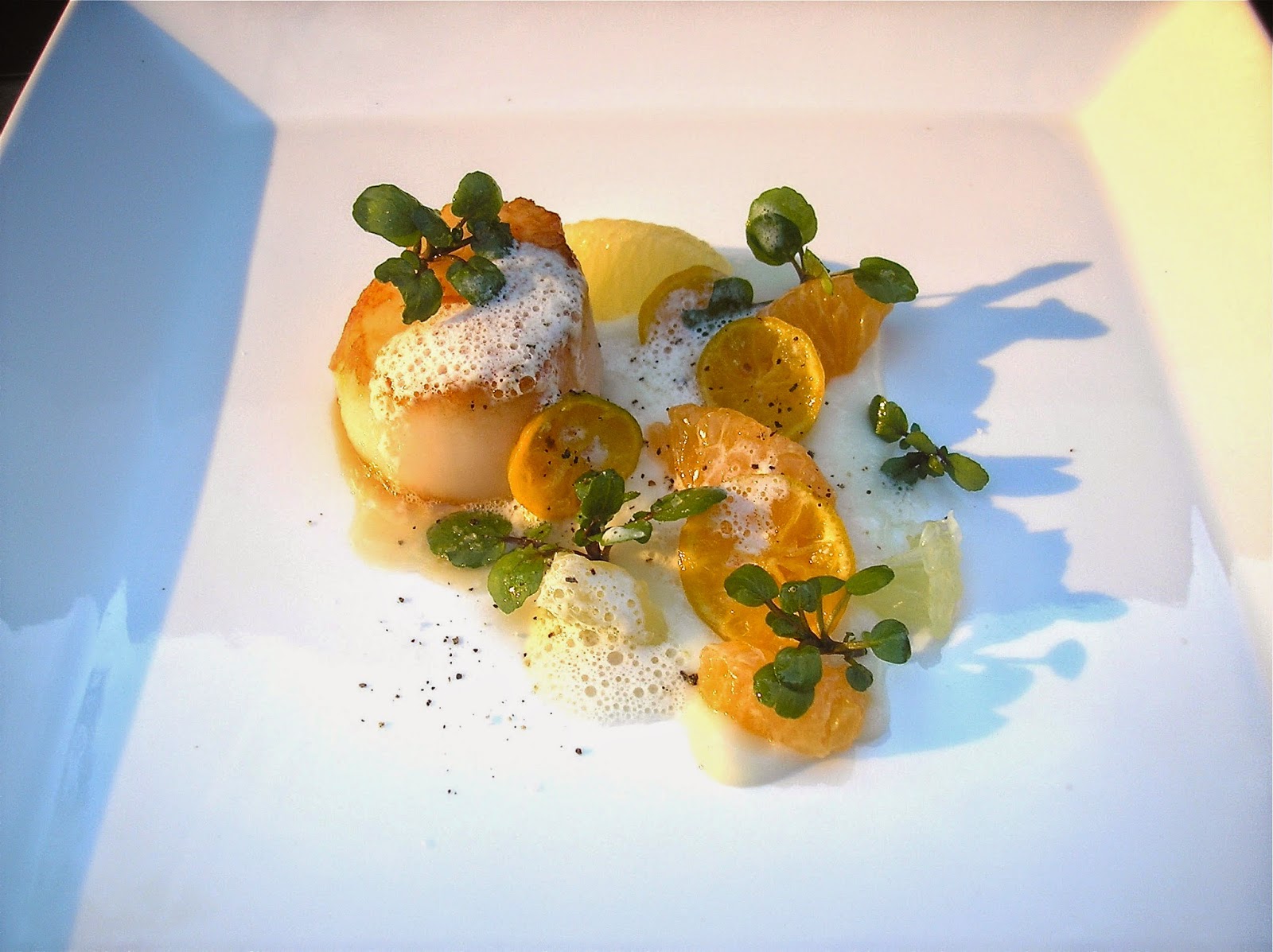
' DIVER SCALLOP, WINTER CITRUS & CRESS .'

Pan seared Wild caught Diver Scallop, Parsnip puree, Kumquats, Meyer Lemon, Imperial Mandarin, Fresh Watercress and Horseradish bubbles.


               This little taster dish has zip and zest, tantalising your taste buds with each mouthful. Using the winter citrus fruits made available at this time of the year, to accompany the sweet tasting diver scallop paired up perfectly and that slight pungency from the horseradish bubbles along with the peppery notes from the cress gave the dish a great complexity of flavours. This dish was a bit of a throw together from the left over scallops from the other days ceviche and the fruit a ha picked up at the local markets to do the miracle berry tasting. I had seen similar pairings done before and more recently by a chef from the U.S.                                                                                                                                  
                 To put this together I made the puree first by boiling some parsnips in salted water until they were soft and tender. I then placed the parsnips with a little melted butter and some cream into a blender and blended to form a puree which was then corrected for seasoning and set aside. I prepared the citrus fruit next, by thinly slicing the cumquats and segmenting the other fruit these were then set aside. Just before plating I foraged the backyard garden for fresh water cress. The cress was washed and dressed in a little olive oil. I then prepared the horse radish bubbles by juicing some fresh horse radish placing into a wide mouth tumbler adding some rice wine vinegar, water, salt, sugar and soy lecithin. With a stick blender, I  then mixed the liquid on high to form the bubbles. Heating a small skillet on a medium high heat I seared the sea scallop on both sides in a little butter for 45 seconds or so, just long enough to turn the flesh opaque and form a caramelised crust.                                                                                  
                 To plate I made a swipe on the plate with the parsnip puree arranging the citrus on top. I then placed the scallop adjacent and top with the horse radish bubbles. I then garnished the dish using the dressed watercress and seasoned with smoked sea salt and cracked black pepper.


Wednesday, 7 May 2014

'the MIRACLE FRUIT PLATTER .'

Fruit platter of Miracle Berry, Kumquat, Tahitian Lime and Meyer Lemon served with Kumquat, Lime & Lemon syrups and fresh ginger mint leaves.


                        Making this dish ticked a box on my to do list finally after a number of years. The miracle berry was first made known to me about 12 or so years ago by my sister whom has a friend that is the owner of 'tropical fruit world', located on the north coast of New South Wales. Tropical fruit world were harvesting these fruits many many years ago and my sister was lucky enough to experience the berries unique properties, prompting me to place this on my to do list. Last weekend we had a friend down staying with us from Townsville and we decided to pay a visit to our local markets on the Sunday. Amongst the many vendors selling plants,seedlings and fruit trees I spotted out of the corner of my eye two small shrubs, one with the berry you see still attached. Which was very rare for this time of the year as they tend to fruit in summer and then again in the onset of spring. So for just $10 AUS. I killed two birds with one stone and was now the owner of my own miracle berry bush with a berry to try for a bonus. For those that are unfamiliar with the fruit , miracle berry contains a protein called miraculin that, when eaten, temporarily effects the tongues sweetness receptors making foods that normally are acidic or sour, sweet. At a neutral ph, miraculin binds and blocks the receptors but at a low ph. (sour foods), the miraculin binds protons and is able to activate the receptors, making these foods sweet. The West African berry itself has a low sugar content and tastes quite tart but having said that miraculin is used commercially as a sugar substitute. An attempt in the 70's was made to commercialise the fruits ability to turn sour foods sweet without a single caloric penalty, but was ended when the ( FDA) declared the berry as a food additive. Controversial claims were made that the project was sabotaged and the research burgled by the sugar industry to avoid loss in business.                                        
                       For this application I used some of the acidic winter citrus that was available in abundance at the markets. I prepared some syrups from Kumquats, lemon and lime by simple juicing the fruits and separately bringing each one to a simmer, removing a little of the juice and adding some arrowroot flour to form a paste. The paste was then placed back into the juice and simmered for a further few minutes, whisking to form a thick syrup. This process was done to each of the three fruits. Next I prepared samples of each fruit to also go on the platter, segmenting the lemon and lime and slicing the kumquat in half. Apart from a quick forage in the back yard for some ginger mint leaves this platter was complete. This was a very simple application but a very theatrical one at that. After consuming the berry, kumquats tasted like marmalade, limes were like key lime pie and the meyer lemons could have been mistaken for lemonade. A truly amazing experience and one that should not be passed up if the occasion arises. Unforgettable.                                                                                        


Monday, 21 April 2014

' MUSHROOMS , MARROW & DATES .'

Grass-fed Bone Marrow in Swiss Brown mushroom stems, Charred Dates, Balsamic reduction and Vegemite paste. 

                Another really simple little dish to make and tastes sensational, the mushrooms have a rich meaty flavour and an almost steak like texture, the dates were pounded to a thin rectangle, adding  sweetness and a roasted flavour. The accompaniments of the balsamic vinegar reduction gives a distinct sweet acidity to balance the marrow out and the Vegemite paste adds a savoury streak for both the eye and the palate. Exquisite grass fed beef marrow has been stuffed into hollowed swiss brown mushroom stems to replicate marrow bones and sauteed in rendered marrow.                                                                
              I started this dish by placing some dried dates on to a tray and into a 180 deg. c. oven for about 20 minutes, until some parts were starting to char. The dates were then removed and placed between two sheets of silicon paper and rolled out to about 2 mm thick. I then made an outline of the rectangle shape using a ruler and marker on to the top sheet of silicon paper before cutting the shape out and setting aside for plating. Next I removed the stems from large swiss browns and hollowed the middles out with a cutter. Scraping some of the raw marrow from the bones I gently filled the stems, these were then placed in the fridge to set. In the mean time I placed a little mandarin juice and balsamic vinegar in a saucepan and brought to a gentle simmer, reducing the vinegar to a thick syrup before removing from the stove and setting aside for plating. The Vegemite was simple thinned with a little olive oil and to finish the dish I sauteed the mushroom stems in a little rendered marrow just before plating.


' CARAMELISED CAULIFLOWER CUSTARDS .'

Caramelised Cauliflower custards served with Garden Pea greens dressed with Barrel aged Fish sauce & Lemon oil .

                     This is a simple little taster dish to put together and a really good little way to showcase seasonal produce. The custards in this dish are extremely dynamic in that it has a great crust, are hot throughout and melts on the tongue like a decadent cauliflower puree rather than the firm set that it resembles. To accompany these I dressed assorted pea greens fresh from the garden in a little aged fish sauce and lemon oil.                                                                                                                                  
                     To make the custards I placed heavy cream, diced cauliflower, salt, cayenne, and cinnamon in a saucepan over a medium heat, I brought this to the boil reducing to a low simmer, covering with a lid. Once the cauliflower was cooked and tender I transferred the mixture to a blender and mixed to form a smooth puree, this was then placed into a small saucepan and brought to a simmer with 1.5% gellan gum whisking to dissolve and disperse the gum. The the puree was then removed from the heat and poured into a plastic mould and placed in the fridge to set. At this time I dressed the pea greens with a little barrel-aged fish sauce and some olive oil mixed with lemon. I kept the pea greens fresh and not cooked to give the dish a little fresh crunch to cut the rich creamy custard. The greens were then plated and ready for the the custards to be re-heated and caramelised. In a medium hot pan I added some olive oil, removing the custard from its mould I sliced the custard into bite sized cubes of which I lightly pan seared one side of the cube before immediately arranging them on to the plate with the pea greens and seasoned with smoked sea salt to serve.


Monday, 31 March 2014

' 64 deg . C EGG YOLK CROQUETTES .'

64 degree C. Sous vide cooked Egg yolk croquettes with Pecorino cheese sauce , Micro greens and truffle salt.

                         This little dish is a take on those creamy spanish croquettes that are served at the many tapas bars. I remember vividly as a child, mum would make beautiful creamy corn croquettes and they were to die for and always a welcomed item at the dinner table. The idea to use egg yolks as the filling came from the molecular recipe website, where they used the method of cooking the yolks sous vide to achieve a gelled structure that can't be achieved by boiling or soft boiling the egg. This dish looks very simple but requires great dexterity and technique when handling these delicate egg yolks. By cooking the eggs sous vide gives us the control and guarantees the perfect temperature of 64 degrees the temperature at which the protein livetin denatures and causes the egg yolk to gel and form a creamy custard like consistency as apposed to boiling where the outside of the egg cooks quicker than the yolk leaving us to guess the condition of the yolk and depending on the size of the eggs an extra 30 seconds too long can turn a soft yolk to a hard boiled before your eyes. The recipe I went off called for the pairing of a nutty flavoured gruyere foam, instead I opted to accompany the croquettes with a cheese dipping sauce made from pecorino cheese, which I think is just as nice.                                                  
                          I first cooked the eggs in their shells in a 64 degree sous vide water bath for one hour. The recipe called to cook the yolks on their own floating in the bath for 45 minutes, turning them at 25 minutes. This method can get fiddly and messy if one ruptures during the cooking process. Once the eggs were cooked I de-shelled them rinsing the unset whites from the yolks carefully under running cold water, these were then placed into a bowl of room temp water until ready to be crumbed. As our pullets have just started laying over the last few weeks, I lost a few yolks to what they call blood spots or meat spots in the yolks, this will be less frequent as they get a little older. But at least I'm assured of fresh free ranged organic eggs at our disposal with vibrant yellow yolks from the supplemented leafy greens in their diets. In a bowl I whisked a whole egg with a pinch of salt, this was for the egg wash. I then seasoned some flour in another bowl and in the last bowl I placed some bread crumbs seasoned with salt and some Dorrego pepper leaf. Using my hands I carefully dusted the yolks with the flour, dipping them into the egg wash and then coating them with the bread crumb. In the mean time I heated some light olive oil, enough to cover the croquettes, in a saucepan to 190 degrees cooking the croquettes one at a time for about 2-3 minutes until they were nice and golden in colour. Bringing the oil back up to 190 degrees each time to assure a perfect shell of crumb around the yolk centres. To make the sauce I heated a little butter in a saucepan and sweated off some finely chopped onions. Once they were clear and translucent I removed them from the pot adding some more butter and a little flour I made a roux to which I added gradually milk to form a white sauce. This was seasoned with truffle salt and grated pecorino cheese was added to complete the cheese sauce.                                                      
                           To plate I smeared the cheese sauce on the plate arranging the croquettes on top and garnished with some micro greens. I seasoned the croquettes with a little truffle infused sea salt.


Saturday, 29 March 2014

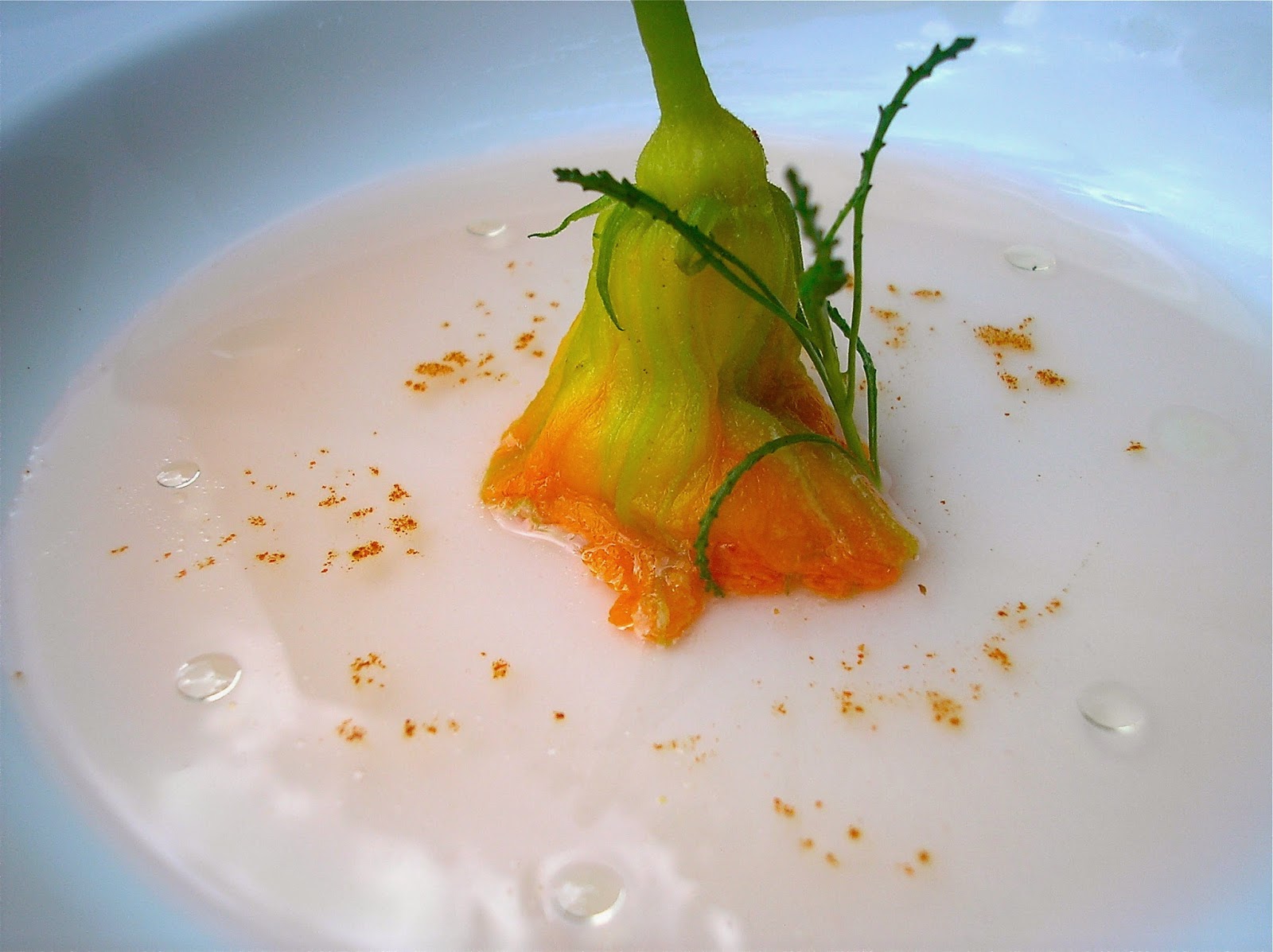
' ZUCCHINI FLOWER with SMOKED COD .'

Zucchini flower stuffed with Smoked Cod mornay served in Chilled sun-ripened Tomato water with White Truffle oil , Sun-dried Tomato dust and olive oil leaf herb.


                          As with many of the dishes I post up here the inspiration starts from whats in harvest in the backyard gardens and at the moment the gardens in transition from the remains of late summer plant outs to the early autumn produce. Here in Brisbane we have the options of planting later summer crops or plant quick growing spring vegetables for a quick harvest, like the quick zucchini crop I put in to receive these wonderfully delicate tasting flowers. The soil temperatures are still quite warm and lend a hand to successful propagation of almost anything. I used the male flower for this dish for two reasons, the first being I want to reap the rewards of a harvest of zucchini and the second being that it simply suits the application better. The last flushes of Roma tomatoes are ripening on their vines and with the recent rain are starting to split and show age cracks on their crowns as they're ready to burst. So with that I decided to do a chilled tomato water to accompany the stuffed zucchini flower. Chilled tomato water resembles the look of a tomato consume but is made purely of filtered seasoned tomato juice rather than the other ingredients that accompany a consume, usually made with white wine or orange and lemon juice flavoured with fresh herbs and seasoned.                                                                        
                         To make this dish I began with the tomato water, chopping the vine-ripened tomatoes in quarters before placing in a blender to form a puree. I then seasoned the puree with sea salt and cracked black pepper before filtering several times through cheese cloth to extract the water and discard the solids and pigment. This was then placed in to a glass and chilled in the fridge until required for plating. Next in a medium sauce pan over a gentle simmer I poached a fillet of beautifully smoked cod from south africa in a little milk and sweated sliced onions until the flesh flaked away from the skin. This was then removed from the heat and allowed to cool before straining the poaching milk and setting aside. I then flaked the flesh, removing any skin and bones, in a small saucepan I made a roux to which I gradually added back the milk, over a medium heat whisking to remove lumps and form a thick white sauce. To the sauce I added a little curry powder and some grated tasty cheese mixing to melt the cheese and bring the mornay sauce together. The the saucepan was then removed from the heat and the poached smoked cod was folded into the mornay and placed covered in the fridge to cool before stuffing the zucchini flower. Once the mixture had chilled, I spooned the mornay into the zucchini flower, brushing the outside of the flower with a little white truffle oil. I then steamed the stuffed flower for a minute and a half before removing from the steamer and chilling before being served. The last application was the tomato dust of which I simply ground sun-dried tomatoes in a coffee grinder to form a powder.                                                                                                                                                  
                          Presenting this dish I placed the smoked cod mornay stuffed zucchini flower upside down, standing upright in a shallow soup bowl, pouring the filtered sun-ripened tomato water in the bowl to cover the bottom of the bowl to 5mm deep. To this I added droplets of summer white truffle oil and sprinkled a little of the sun-dried tomato dust, before garnishing with a sprig of fragrant olive oil leaf herb to finish. This is a delicate, but robust flavoured dish served chilled or warm as an entremet.


Saturday, 22 March 2014

' 54 deg . C BANANA PRAWN in PEA WATER .'

54 degree C. Sous vide cooked Queensland Banana prawn in a Chilled Pea water & Celery juice broth with Nameko mushrooms, Charred onions, Thai basil, Pea butter & greens.


               In many styles of food over the years, the chefs, cooks, housewives of the world abroad strive to cook meals with complexity and richness in flavour, with meals displaying layers of depth. In the modernists kitchens of today meals are being prepared using a minimalist approach to ingredients but showing execution of great techniques in showcasing these few ingredients and enhancing them. This dish is a good example of bringing out the raw flavours of each ingredient. The onions have been sauteed and caramelised to bring out the sweetness of the onion, the prawn was cooked in a 54 degree C. sous vide water bath with only butter and garlic to accompany. This allowed the prawn to cook evenly trapped in its own juices. I've seen the pea water prepared a little different to mine, with the use of a centrifuge, pea puree is spun at 1200 g's separating the liquid from the solid. My way still requires a pea puree but then this is manually passed several times through a cheese cloth filter. This technique removes the starch from the pea and it is starch which inhibits the body from tasting sweetness. So with most of the starch removed, it leaves the pea water tasting sweeter than the original whole peas used.
              I began by making the juices needed for the pea and celery water, first I put a pot of peas on the boil and roughly chopped celery into chunks. One serving requires 15 g of pea water and 5 g of celery juice so be sure not to over do it. I juiced the celery and ran it through a cloth filter several times before pouring into a glass jar and placing in the fridge to be chilled. Once the peas were cooked I drained them placing into the blender with some cold water and forming a puree. This was then ran through a cloth filter several times and poured into a jar before placing in the fridge to chill. While these were chilling I prepared the prawns in food safe plastic pouches along with a little butter and some garlic paste. This was then vacuum sealed with the food-saver and placed into a 54 degree c. sous vide water bath for 12 minutes. The pouch was then removed and placed directly into an ice water bath and the into the fridge to chill. In a skillet I quickly sauteed some nameko mushrooms and pearl onions before removing. I sliced the onions in half and returned them to a hot skillet face down to caramelise.
            To plate a placed 5 g of filtered celery juice and 15 g of pea water into the base of the bowl. In the centre of this I placed the sous vide prawn topped with pea greens and arranged the nameko mushrooms, micro purple thai basil leaves, charred onions and the pea butter around the edge of bowl.


Tuesday, 18 February 2014

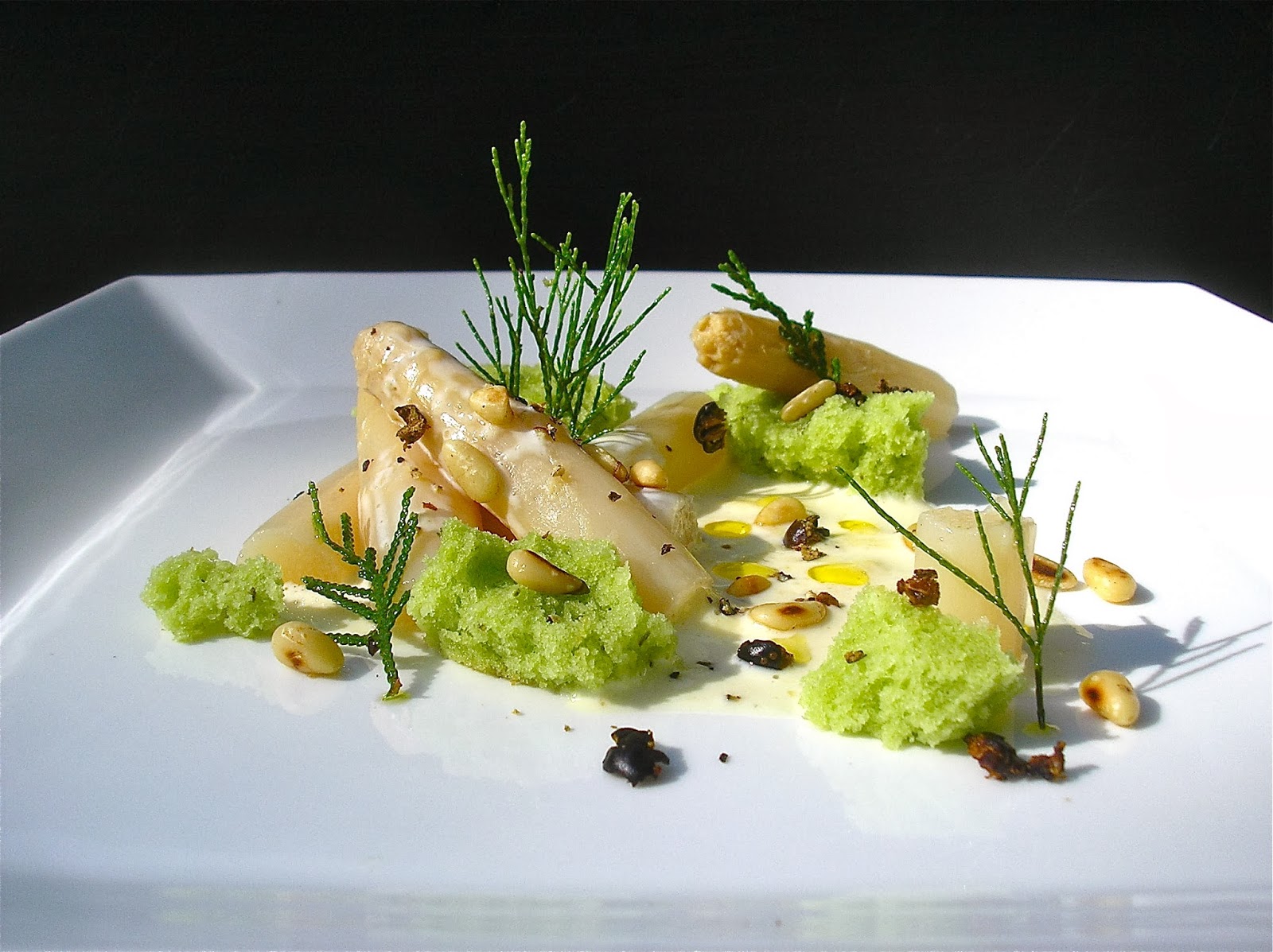
' WHITE ASPARAGUS , WILD PINE & CONIFER .'

White Asparagus poached in a cream sauce , Pine Genoise sponge , Toasted pine nuts , Juniper berries , Pine oil , Conifer fronds and new season pine shoots.

                     I stumbled across this pairing a few months ago and have wanted to give it a try ever  since. So when finally white asparagus made its way to the shelves, I went about foraging for a good source of wild pine and conifer trees growing in the neighbouring parklands. In this dish I infused sugar with pine needles and then used the sugar to make the genoise , which is a form of sponge named after the Italian city of Genoa. The genoise sponge is known for not using chemical leavening but giving the cake its volume through a technique of suspending the batter with aeration. Unlike a basic sponge the eggs are separated and introduced to the mix by creaming the yolks first with sugar and then down the track folding in the egg whites. The original recipe called for the use of essential pine oil of aroma therapy quality, I opted for infusing olive oil with pine needles over a low heat to make the pine oil instead, as I find the essential oil to overpowering for this application.                                                          
                      I began preparing this plate by making the genoise first. To do this I first placed sugar and pine needles in a coffee grinder and pulverised to a powder pouring through a sieve to remove the chaff. I then placed the sugar and egg yolks in a bowl and beat until tripled in size. To this I added a little green colouring and plain flour and some corn starch and whisked to form a batter. In a separate bowl I beat egg whites with a little cream of tartare to a soft peak and folded this carefully into the batter before pouring into a lined cake. The sponge was baked in a 180 deg.c oven for around 15 minutes before turning out on to a wire rack to cool. While this was cooling I prepared the asparagus by chopping into pieces and poaching in a little cream and salt and pepper until soft and tender. The asparagus were then removed from the heat and set aside for plating later. To make the pine oil I simply infused pine needles in olive oil over a low heat for about 45-50 minutes before cooling. To accompany I dressed the conifer fronds and pine shoots in olive oil and toasted some pine nuts in a hot skillet. to finish I cracked some pepper medley over the dish and crushed some juniper berries for more of that alpine touch of flavour.


Friday, 14 February 2014

' WHITE TRUFFLE & EGG CUSTARD .'

Savoury Custard of Hens egg yolks & White summer Truffle , White Truffle oil , Fresh Water hyssop , Black caviar , Smoked salmon mousse and pea greens.


                  I love this dish, a delicate hens egg shell and within a rich, velvety, aromatic and decadent custard. In this case a summer dish using oil infused with summer white truffle as the flavour but I've seen this dish served in many different ways. For my dish i've used smoked salmon mousse for the base to hold the egg shell cup upright and along with the pea greens makes a great accompaniment to the custard. Keeping with the egg theme I topped the custard with a little lumpfish caviar.                                
                 To make this I first cracked a couple of eggs using a sharp knife carefully, leaving about two thirds of the bottom of the shell in perfect shape. This is a rather hard thing two achieve, with the eggs I separated the yolks. I then whipped the yolks with some whit truffle oil and adding to this some cream, milk, and sherry vinegar . Whipping until mixed together I poured the mixture into a small saucepan on low heat I cooked the custard until thick and creamy before removing from the heat to rest. I then cleaned the inside of the shell removing any membrane and trimmed the rim as best I could.                      
                To serve I placed three quenelles of smoked salmon mousse in the centre of the plate which was made by simply blending smoked salmon with cream cheese to a paste. In the middle of the salmon mouse quenelles a placed the the egg shell and carefully spooned the custard to fill the shell. I drizzled white truffle oil over the custard topping with black caviar and fresh water hyssop. I placed a section of fresh pea greens in front of the egg and mousse to garnish the dish.


Monday, 10 February 2014

' BROCCOLINI & MISO BUTTER .'

Broccolini steamed , Wakame shiro miso butter , Mirin honey , Toasted white sesame seeds , Roasted peanuts & wild rocket flowers.

           Here we have another really simple vegetarian dish with Japanese influence, using fermented ingredients again to give complexity and the unami flavour not able to be achieved with vegetables on its own. Fermented products such as soy and miso can also supply a vegetarian diet with vitamins, minerals, enzymes and good bacteria needed for optimal health. The concept of the miso butter comes from world renown Korean American chef David Chang and goes with almost any vegetable. The mirin honey lends a complete balance of sweet and sour, while the roasted peanuts and toasted sesame seeds give textural contrast and a unique nutty flavour from the oils in the seeds and nuts which pair perfectly with the richness and salty miso butter. I used wakame shiro miso for this dish which is my favourite of the miso pastes with its subtle seaweed flavour. Wakame is an edible sea vegetable which comes from the cold temperate waters of the Japanese coastline and shiro means white, putting it all together you've got wakame shiro miso or  white miso with seaweed. This type of miso paste is usually used in soups or salads but is also perfect for this application.                                                                  
             In making this simple Japanese entremet I started by whipping some miso paste with unsalted butter until soft and homogenised, this was swiped onto the plate using a silicon spatula. The butter can be kept for quite a long time so you can make a bigger batch and keep the remaining in the fridge for later purposes. In a saucepan I put some water on the boil, lowering to a simmer I placed some broccolini florets in to a steamer basket over the simmering water and steamed the broccolini until cooked but still firm, this was then removed and placed into an ice bath to cool before arranging at both ends of the miso on the plate. The mirin honey was made simply by combining the mirin and honey together, this also can be kept for quite some time stored in the pantry in a sealed bottle. I drizzled the mirin honey on both sides of the miso butter. In a hot skillet a toasted off some sesame seeds placing them on top of the broccolini with some wild rocket flowers. And last of all in the same hot skillet I toasted some chopped peanuts placing next to the broccolini to accompany the dish.