Saturday, 15 February 2014

' QUAIL , poached PEAR & SWEET POTATO .'

De-boned double breast of Quail roasted , Sweet potato & pear puree , Brandy Poached mini Pear , Quail jus , fresh pear salad , pea greens and micro sage leaves.


                  While out browsing the deli shops and Italian grocers the other day I made a special trip to this particular store that sells a small range of gourmet products and quail was what I was after. They never let me down and I walked out with some white asparagus six birds at $4 AUS. each. The pears in this dish are a mini variety I purchased while doing the weekly groceries. They were labeled 'paradise pears' by Zahra farms, Yenda NSW. I'm suggesting they are some kind of new season pear variety.      
                  The preparations for this dish are listed by name below and are in no order to follow as I prepared all the elements first and cooked them all at the same time its harder to explain in writing.
  QUAIL - The quail was first cut down the breast plate and turned over back side up and flattened. The legs from the top of thighs were removed as to the wings, leaving just the the double breast or torso. Using a sharp knife I ran the blade between the breast fillet and the rib cage and cut the meat away from the ribs up to the back bone and doing the same to the other breast fillet. Once I had achieved this I flipped the quail over so it was on its back and with the rib cage now free but the back bone still attached I used a pair of scissors to cut between the backbone and the skin and little flesh their is. I now removed the whole backbone and ribs from the bird leaving behind a de-boned perfect, skin on double breast fillet of fresh quail meat. This was then rinsed under cold water and checked for remaining bones before being pat dry. I then filled the pocket between the two breasts with sage leaves, folding the breasts back together I placed three toothpicks at the base of the meat to hold the the two fillets together while cooking. In a hot pan with some olive oil I placed the seasoned quail skin side down and cooked to brown the skin and seal the meat. Once the meat lifted easily without force and was browned I turned it over and cooked for a further 5-6 minutes. I then placed the quail into a roasting dish with a wire rack with water at the bottom of the pan and into a 160 deg.c. oven and baked the quail until the juices changed from running red to running brown, well I like mine with no blood anyway the cooking is preferential. The quail was then removed and allowed to rest before pulling the toothpicks out. I retained the juices from the roasting pan to make the jus.        
   JUS - I placed the cooking liquid, skimmed of fat retained from roasting in to a saucepan and simply brought the stock or jus ( juice from itself ) to a gently simmer and reduced the sauce to a thick syrup.    
  PUREE - I made the puree by simply placing cooked sweet potato, chopped fresh pear and a little cream in a blender and processing to a smooth consistency before being reheated when served.                    
  SALAD - The pear salad is a simple brunoise of summer pear dressed with extra virgin cold pressed olive oil and lemon juice with a seasoning of cracked pepper medley and smoked sea salt.                      
  PEAR - I poached the pear by first bringing some Cretan white sweet brandy made of honey, thyme and distilled grape must, a little water, sugar, honey, thyme and lemon juice and zest to the boil and then removed from the heat while I prepared the pear by peeling and trimming a slice from the bottom of the pear so it can stand freely. This was then placed into the brandy syrup and returned back to the stove and brought to a simmer . The pear was then ladled with the syrup and poached with a lid on the saucepan until tender and translucent, spooning syrup over the pear at regular intervals during the poaching, for a pear of this size it only took about 15-20 minutes. The pear was then removed and set aside and allowed to cool before being plated.


Friday, 14 February 2014

' deconstructed LEMON MERINGUE PIE .'

Deconstruction of a Lemon Meringue Pie - Lemon Curd , Crumbled short crust pastry , Toasted Meringue, Crumbled meringue , Lemon gelato , Lemon zest , Lemon sherbet and micro lemon balm leaves. 

                   Those that follow the blog or have browsed before may remember the deconstructed carrot cake. Lately this dish has attracted attention and raced up the most viewed in particular the states. Well I decided to release the second of my deconstructed desserts ' Lemon meringue pie'. In this dish I've pulled apart an old classic pie in a modernist fashion played with the elements of the recipe and presented the peoples favourite pie deconstructed. There are four lemon elements and two meringue elements, and there is the lemon balm leaves and of course the crumbled pie base. Lemon meringue is one one of my lovely wife Melanie's favourite dessert pies and she gave this dish a big thumbs up, with comments of incredible if I recall proudly.
                  The lemon gelato was the first prep and was started the night before by juicing some lemons and in a saucepan adding the juice and half that amount of sugar. This was gently brought to the simmer reducing by a third until thick and syrupy before being set aside to cool. In the meantime in a bowl I beat egg yolks and sugar until pale and creamy, to this I added some cream and milk and poured the mixture into a saucepan on low to medium heat stirring while cooking until the custard becomes thick and coats the back of the spoon. The custard was then removed from the heat and the lemon syrup was added gradually before pouring the mix into an airtight container. The mixture was allowed to cool before being placed into the freezer overnight, the next morning the the gelato was scooped onto a blender and processed until smooth before being poured back into the airtight container to be placed in the freezer for a further four hours.
                While this was freezing I let egg whites stand in a bowl at room temperature for half an hour before beating the egg whites with a little lemon essence, and cream of tartare on medium in an electric mixer until soft peak stage. Gradually I beat in some sugar tablespoon at a time on high to form stiff peak stage. I then spooned the meringue into a piping bag with a large star nozzle fitted and piped the meringue in strips onto a baking paper lined flat tray. The meringues were then placed into a 140 deg.c. oven and bake for 45-50 minutes until hard, dry and set. The oven was turned off and the meringues were left to harden in the oven with the door closed for around an hour before being removed and set aside to fully cool. Once cooled I broke some large pieces apart and toasted them and crumbled some more into a large crumb. The lemon curd was next and was made by placing butter, sugar, lemon rind and lemon juice in a heat proof bowl over a saucepan of simmering water avoiding the bowl from touching the water I cooked, stirring constantly for around five minutes dissolving all the sugar. The bowl was then removed from the heat whisking in beaten eggs the mixture was returned to the heat and cooked for a further 8 or so minutes until the curd coats the back of a spoon.
                 To make the sweet short crust pastry crumb I simply brought flour, butter and sugar together in a food processor to make a fine crumb. To this I added egg yolks and brought the dough together, this was then turned out on to a floured board and rolled out to 5mm thick and placed between baking paper and placed in the fridge for half an hour. The pastry was then removed and baked until golden before being crumbed fine. The lemon sherbet is a mix of caster sugar, lemon oil, and a little citric acid. This was placed in a coffee grinder and ground to a fine powder.


' GARLIC & GINGER SCAMPI with AVOCADO .'

Grilled garlic & ginger Scampi , Smoked salmon mousse , Avocado & Ginger mint puree , Edible sand , dried nori and pea greens.    

                   Summer inspired seafood entree of garlic and ginger grilled scampi accompanied by a smoked salmon mousse and avocado puree. Keeping with flavour of the sea I served an edible sand made from crumbs and other goodies of sea nature such as salts, dried fish, seaweed etc. The avocado puree remains fresh on the palette with a hint of ginger mint to lift it as well as lime juice, instead of the ever so popular guacamole pairing of avocado and garlic.                                                                        
                   Halving an avocado and removing the seed, I scooped the flesh from the skin into a blender with a little cream, lime juice, fresh ginger mint and a little seasoning. This was bended to form a smooth lime green puree nice and creamy. I then split a large scampi in half lengthways and cleaned the head cavities of the scampi halves. Making a basting sauce from butter, minced garlic and ginger I coated the flesh of the tail meat and filled the head cavity. I then placed the scampi flesh side up on a flat tray and placed the tray under the grill to cook for around 8-10 minutes, basting the meat every 2 minutes while their cooking. Once their cooked I removed the tray from under the grill and let them rest. In the meantime I placed some cream cheese, cream and smoked salmon in a blender and blended the mixture to a mousse consistency. To make the edible sand I mixed in a bowl some panko crumb, bread crumb, black and white sea salt, pink salt, ground dried fish, ground dried nori seaweed, evaporated sugar cane juice and wakame miso oil. The miso oil is simply sesame oil mixed with wakame miso paste and is rubbed through the crumb mix just before serving.                                                                
                    I plated this by swiping the top half of the plate with chilled avocado and ginger mint puree. I then arranged the scampi halves on the plate showing the succulent tail meat to the diner. With the salmon mousse I made four quenelles and arranged them between everything else on the plate and garnishing them with a slim strand of dried nori seaweed. With a spoon I carefully placed mounds randomly on the plate of the edible sand  and then finished the plate off with some fresh pea greens.


' WHITE TRUFFLE & EGG CUSTARD .'

Savoury Custard of Hens egg yolks & White summer Truffle , White Truffle oil , Fresh Water hyssop , Black caviar , Smoked salmon mousse and pea greens.


                  I love this dish, a delicate hens egg shell and within a rich, velvety, aromatic and decadent custard. In this case a summer dish using oil infused with summer white truffle as the flavour but I've seen this dish served in many different ways. For my dish i've used smoked salmon mousse for the base to hold the egg shell cup upright and along with the pea greens makes a great accompaniment to the custard. Keeping with the egg theme I topped the custard with a little lumpfish caviar.                                
                 To make this I first cracked a couple of eggs using a sharp knife carefully, leaving about two thirds of the bottom of the shell in perfect shape. This is a rather hard thing two achieve, with the eggs I separated the yolks. I then whipped the yolks with some whit truffle oil and adding to this some cream, milk, and sherry vinegar . Whipping until mixed together I poured the mixture into a small saucepan on low heat I cooked the custard until thick and creamy before removing from the heat to rest. I then cleaned the inside of the shell removing any membrane and trimmed the rim as best I could.                      
                To serve I placed three quenelles of smoked salmon mousse in the centre of the plate which was made by simply blending smoked salmon with cream cheese to a paste. In the middle of the salmon mouse quenelles a placed the the egg shell and carefully spooned the custard to fill the shell. I drizzled white truffle oil over the custard topping with black caviar and fresh water hyssop. I placed a section of fresh pea greens in front of the egg and mousse to garnish the dish.


Thursday, 13 February 2014

' CHICKEN & CAMEMBERT SAUSAGE .'

Free range Chicken , camembert & saute onion sausage , Ragout of Legumes , Apple cider jus , sauteed onions and Lemon thyme sprigs.

                 This plate was put together from all kinds of ingredient foraging once again, and I guess began with the borlotti beans I planted in spring and left to become a dried bean crop for autumn and winter meals, they've just been harvested over the last couple of weeks and now will be left some where dark and with a draft to dry. The sausage I used for this dish I can't claim any credit for other than discovering this fine cuisine while shopping. Both the accompaniments, the saute onion and the lemon thyme are also from my garden, in fact the thyme grows like a living carpet in my patch but every common thyme plant I try to grow fails.                                                                                          
                This was a very easy dish to put together and began with washing some dried mixed legumes ( red kidney, butter bean, chickpea & cannellini ) under cold water before placing into water to cover in a saucepan and brought to the boil. I then reduced the heat to a simmer adding a bay leaf, two halves of a caramelised onion, chopped carrot, parsley bunch tied up and pepper and salt. This was left to simmer until the legumes were cooked and soft in the centre, of which I then removed the pot from the stove and strained the liquid through a sieve. The onion halves, carrots and parsley were removed and the legumes were set aside. I then peeled and sliced some homegrown baby onions and sauteed them in a little butter in a medium hot pan until soft and translucent, these were then removed from the heat and set aside. Heating a little olive oil in the same pan and bringing the pan to  medium hot, I cooked the sausages rolling them around to prevent burning but also to give a good colour all over. Once these were cooked I set them aside on a plate to rest before slicing for plating. Working quickly I deglazed the pan with some three oaks apple cider lifting the caramelised bits from the pan. Stirring in a little arrowroot flour I reduced the jus to a thick honey consistency.                                                                                                  
                For the plating I spooned rounds of the jus on to the plate, slicing the chicken, camembert and saute onion sausage into various sizes and arranging them just offset of the sauce. I then placed the ragout of legumes along side of the pieces of sausage and the borlotti beans were left fresh as is washed and straight from the pod to the plate to give a contrasting crunch to the dish also to showcase the harvest. I then finished the plate by drizzling some jus over the sausage and and topping with sauteed onions and sprigs of fresh lemon thyme.


Tuesday, 11 February 2014

' SCAMPI , GOOSE LIVER & PASSIONFRUIT .'

Grilled Scampi tail meat , Pate de foie gras , Passionfruit curd  , Passionfruit pulp and toasted macadamia nuts.

                       Well I must admit cooking scampi is a first for me and may seem rather odd to the europeans out their but the fact of the matter is scampi is just not readily available here in Australia and especially the waters of south east Queensland. I guess our scampi would be banana, red spot or tiger prawns or the unusual Moreton bay bug. The closest anatomically would be the fresh water Red claw but with an entirely different taste all together. All in all scampi tastes very much like prawn and looks very much like an oversized prawn but with claws instead of nippers. This flavour combination of scampi, pate and passionfruit sounds odd to say the least but surprisingly works perfectly. Pate de foie gras is pate or paste made from duck or in this case fattened goose livers, foie gras meaning fat liver. My intentions originally were to accompany the scampi tail with foie gras entier which is the geese livers served cooked and sliced but this is yet another hard sourced ingredient and I was only able to get a hold of foie gras in a tin imported from france. The presentation and effect would not have been the same so I turned the livers into a pate instead. In the past and the practise still goes on in some corners of the globe, the geese were raised on a force fed diet. Handlers would hold the necks of the geese and force figs down their throats to fatten them up in turn fattening their livers for the production of foie gras. This method no longer exists in modern day animal raising due to the up roar of the activists and was stopped, but many countries claim to have held on to the traditional methods and revived them. Below is a depiction of this method of geese raising in early Egyptian times, chefs of the late 1800's claim to have seen livers of up to three pounds in weight by using this method. As I've seen many times in nature, when something is enlarged artificially or oversized crops on the one plant are produced the yield becomes greater but quality is compromised. I would tend to say this would be the case in fattening livers by force feeding, not to mention the stress on the animal and what that does to the taste and the overall texture of the product. I've seen this first hand while vine pruning for a boutique vineyard in the McLaren vale region. The viticulturist had specifically asked me to reduce the budding points or fruiting points on each vine to improve the overall quality of the berries. As a result of this technique, that vintage of shiraz one a gold medal in a few wine shows which gave me great satisfaction that my hard work had been rewarded and I'd lent a big hand in achieving a quality product.  
                     I set out making the pate for this dish by melting some butter in a fry pan, I then added onions and sauté until soft. I then turned the heat up and browned of the livers, in my case the livers came already cooked so I was basically just adding some caramelisation to the pan. Once ready I deglazed the pan with some brandy lifting off any bits stuck to the pan to this I added some more butter and some cream and this was placed into blender and pureed until smooth. I then tasted for seasoning and corrected accordingly before pouring into a greased mould and placed in the fridge to set ( about 3 hours). During this time I melted some more butter and poured it over the semi set mousse to seal. The passionfruit curd was made by simmering some passionfruit puree with a little agar agar, whisking to dissolve the agar. The puree was then removed from the heat and swiped on to the plate with some fresh pulp and seeds. I then cut the tail off the scampi and removed the shell leaving the tail flap. I brushed the meat with garlic butter and grilled for about 10 minutes or just as the meat starts to take colour of which I then removed and chilled. In a hot skillet I toasted off some chopped macadamia nuts to give the dish some textural contrast.
                    To plate I swiped the sauce on the plate adding some seeds and pulp. I then arranged pieces of the pate de foie gras and top them with the scampi tail meat, drizzling sauce over the meat. I then scattered the macadamia nuts on the plate to accompany.


Monday, 10 February 2014

' BROCCOLINI & MISO BUTTER .'

Broccolini steamed , Wakame shiro miso butter , Mirin honey , Toasted white sesame seeds , Roasted peanuts & wild rocket flowers.

           Here we have another really simple vegetarian dish with Japanese influence, using fermented ingredients again to give complexity and the unami flavour not able to be achieved with vegetables on its own. Fermented products such as soy and miso can also supply a vegetarian diet with vitamins, minerals, enzymes and good bacteria needed for optimal health. The concept of the miso butter comes from world renown Korean American chef David Chang and goes with almost any vegetable. The mirin honey lends a complete balance of sweet and sour, while the roasted peanuts and toasted sesame seeds give textural contrast and a unique nutty flavour from the oils in the seeds and nuts which pair perfectly with the richness and salty miso butter. I used wakame shiro miso for this dish which is my favourite of the miso pastes with its subtle seaweed flavour. Wakame is an edible sea vegetable which comes from the cold temperate waters of the Japanese coastline and shiro means white, putting it all together you've got wakame shiro miso or  white miso with seaweed. This type of miso paste is usually used in soups or salads but is also perfect for this application.                                                                  
             In making this simple Japanese entremet I started by whipping some miso paste with unsalted butter until soft and homogenised, this was swiped onto the plate using a silicon spatula. The butter can be kept for quite a long time so you can make a bigger batch and keep the remaining in the fridge for later purposes. In a saucepan I put some water on the boil, lowering to a simmer I placed some broccolini florets in to a steamer basket over the simmering water and steamed the broccolini until cooked but still firm, this was then removed and placed into an ice bath to cool before arranging at both ends of the miso on the plate. The mirin honey was made simply by combining the mirin and honey together, this also can be kept for quite some time stored in the pantry in a sealed bottle. I drizzled the mirin honey on both sides of the miso butter. In a hot skillet a toasted off some sesame seeds placing them on top of the broccolini with some wild rocket flowers. And last of all in the same hot skillet I toasted some chopped peanuts placing next to the broccolini to accompany the dish.


Sunday, 9 February 2014

' SWEETCORN & ASPARAGUS SALAD .'

Warm salad of Sweetcorn & Asparagus , Wakame Shiro miso, Sauteed onions , Toasted sesame seeds & Shichimi Togarashi .

                    This is a taste sensation and is simple and quick to make. Essentially a vegan friendly warm salad of sweetcorn and asparagus using the bold flavours of spice and heat with that savoury unami flavour from the fermented miso paste to help add a rich deep element to the otherwise light fare. The dish was seasoned with the japanese chilli spice shichimi togarashi, a spice mix containing seven flavours ( black and white sesame seeds, poppy seeds, roasted orange peel, sancho, ginger and nori). The asparagus in this dish was supplied by friends of ours (Buchanan's produce) and are local to the area, growing the freshest of organic produce and a decent size flock of dorper lambs. Many thanks Warren and co. for the gesture and the ongoing inspiration and knowledge in growing good food.    
                    Together in a bowl I mixed some shiro miso, rice wine vinegar and mirin to a paste before making a swipe on the plate. Standing a cob of corn on its end I cut the kernels of corn from off the cob with a sharp knife. I cut the asparagus into small pieces and sliced a small onion finely. With a little butter I sauteed (sweat) the onions off before removing, turning the heat up and cooking the corn and asparagus. I first laid a bed of sauteed onions across the swipe on the plate before placing the corn kernels on top of the onions followed by the asparagus. I seasoned the plate with some toasted sesame seeds and some Japanese seasoning shichimi togarashi.


' FIG LEAF CIGAR .'

Caramelised fig & Ashed goats cheese rolled in a Toasted fig leaf , Dipped in honey , Cinnamon sugar and Fig leaf ash.

                    Another from the team at 'moto' and makes a perfect pre dessert dish experimenting with fruit and cheese with the smokey, caramel notes of the toasted fig leaf. This dish is surprisingly yummy and upon first glimpse for one, looks like it shouldn't be eaten or two belong on the dining table. This is a great example of playing with food and like its name sake makes the perfect dish to be served as the smoke break in a long 8 or so course degustation menu. The goats cheese provides the perfect amount of tanginess to the plate where as the caramelised fig gives the sweet, smokey charred flavours.                
                    This was a very simple dish to make and I first cut some figs in half, sprinkling them with a little panela and placing them under the grill until soft and caramelised. I then removed the figs from the grill allowing to cool. I then harvested and washed some medium sized fig leaves. I laid one leaf out vein side up, smooth side down and placed a length of one cm. diameter rolled cheese along the length of one side of the leaf. Spooning the fig alongside I rolled the cheese and fig in the leaf to form a cigar shape, tying string around both ends to hold its shape, I placed the cigar under the grill and toasted the outside of the rolled leaf until dark brown in colour. The cigar was then removed from the heat and the strings cut away for serving purposes. To make the ash I toasted fig leaves and crumbled them with a little cinnamon sugar. To plate I dipped the end of the cigar in honey and the fig leaf ash and placed the cigar and ash into an ash-tray in the centre of the plate for presentation.


Friday, 7 February 2014

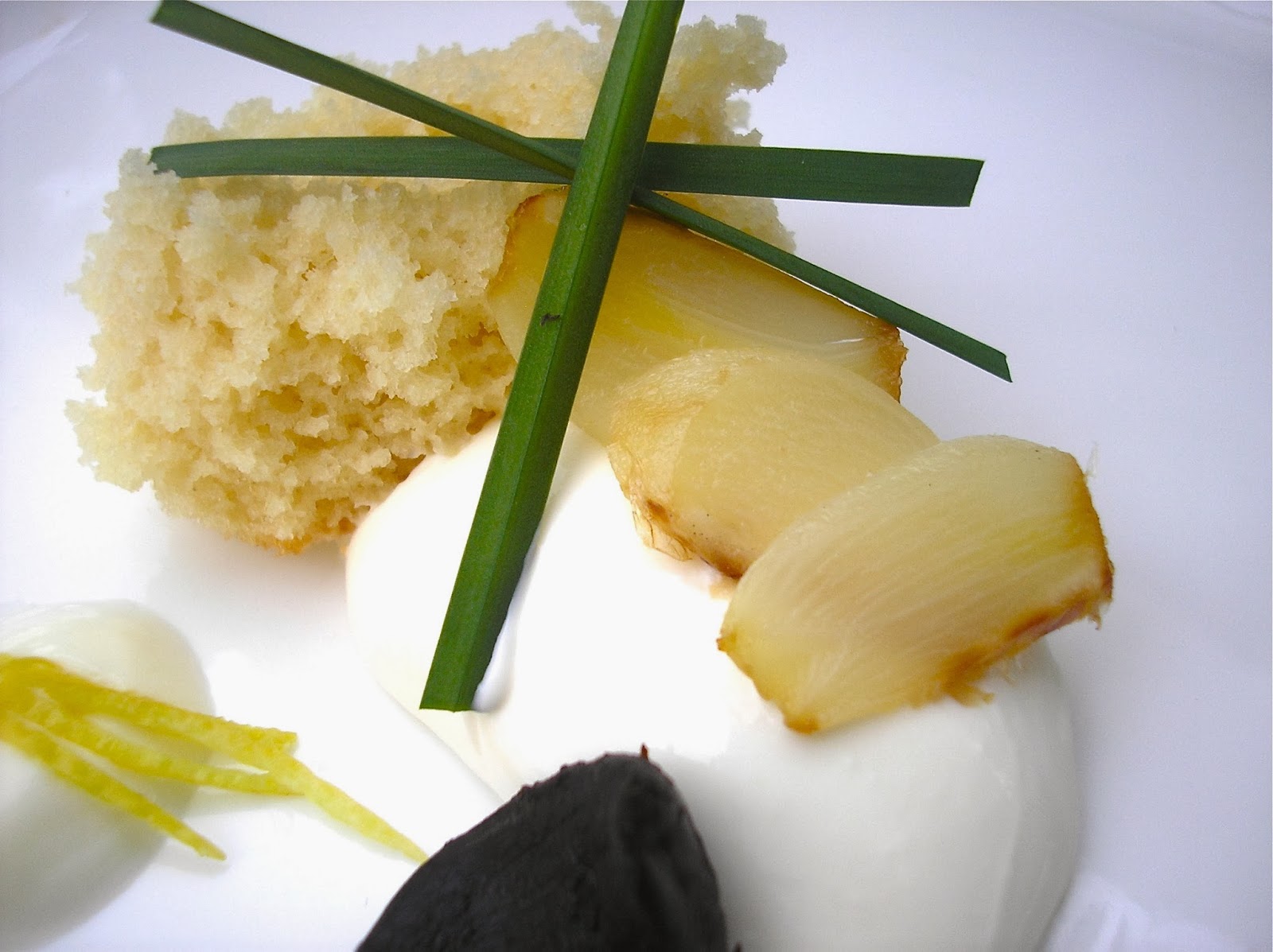
' GARLIC & SOUR CREAM .'

De-hydrated garlic butter sponge , Black garlic , Sour cream , White wine poached garlic , Garlic aioli , Lemon zest and garlic chives.


               In the back of everyones mind right now their thinking, 'the breath after this dish, can't do this one theres way too much garlic, pungent' . Well surprisingly this dish is full of techniques applied to garlic that brings out the under notes of a garlic clove rather than its raw pungent state. While out browsing the shelves after work this week I came across the black garlic you see. I've heard of this before but never seen or used garlic in this state. Black garlic sometimes wrongly referred to as 'black fermented garlic' is garlic which has been heat treated in its skins whole for several weeks resulting in the black cloves and not subject to microbial influence at all. Losing its pungent flavour in the process, black garlic parts flavours of tangy, sweet and syrupy with hints of balsamic vinegar or tamarind paste. Another application Garlic was used was poached in white wine also giving sweet flavours although contrasting to that of the black garlic. Two other preparations in this dish using garlic were the aioli and the garlic butter sponge and I brought in some colour and a fresh ingredient by using garlic chives to garnish. The change up and accompaniment is sour cream and a little lemon zest.  
              To make this garlic tasting I started by making the sponge first. In a bowl I beat some eggs until frothy and added some sugar and smoked salt, whisking again. In another bowl I melted a little butter with some de-hydrated garlic granules, this was then cooled and added to the eggs with some cold milk and a little baking powder, this was beaten until foamy. To this I worked in some self raising flour to form a batter, this was poured into a lined baking tin and baked at 160 deg.c. for about 20-25 minutes. Once the sponge was ready and sprang back to form when pressed, it was removed and allowed to cool before being torn apart for presentation. The poached garlic was simply simmered with a lid on low heat in a mix of butter and sweet white wine until soft and tender. The garlic was then removed and allowed to cool before being sliced thinly for plating. To make the aioli I placed egg yolks, crushed garlic, salt and sherry vinegar in a blender and blended to a creamy pale consistency, with the blender still running I trickle fed olive oil in slowly to form a creamy garlic aioli.                          
              To plate I placed a generous dollop of sour cream in the centre of the plate placing a chunk of torn garlic butter sponge to one side and some sliced poached garlic on top of the cream. In front of this display I placed whole cloves of the black garlic and a smaller dollop of the garlic aioli which was garnished with strips of lemon zest. A few lengths of garlic chive were arranged on top of the sponge and sour cream display to finish the plate off.


Sunday, 2 February 2014

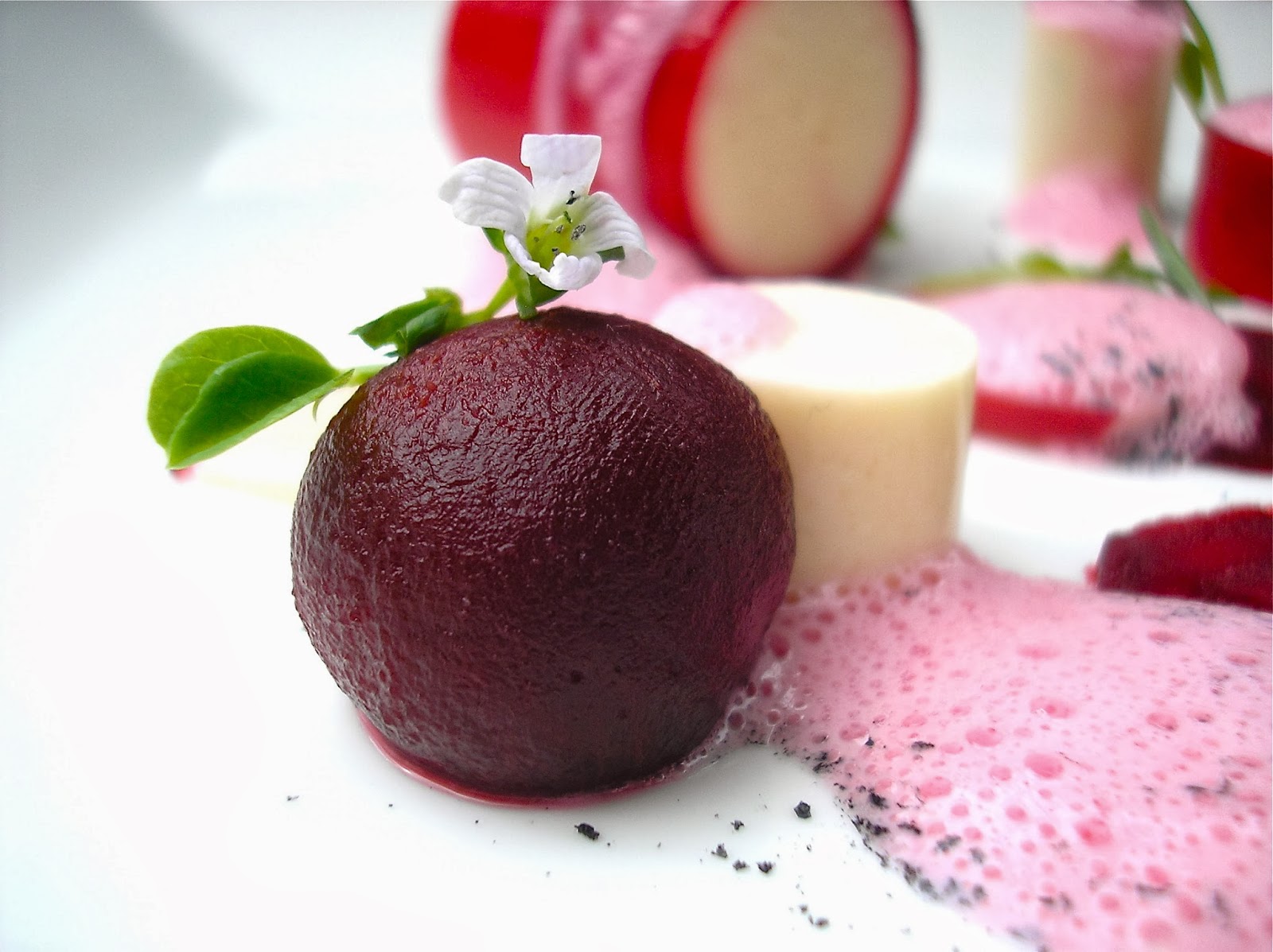
' BEETROOT & GOATS CHEESE SALAD .'

Goats cheese & Beetroot roulade , Goats cheese panna cotta Whole pickled & Sliced fresh baby beets , Beetroot & goats milk emulsion, Pea greens , French tarragon , Water hyssop flowers & Cypress black salt.


                     Just the one post this week, a little slack I know but I guess one is better than none. I've been a bit busy finishing the chook palace in the back corner of the yard, stage one of what I call 'protein corner'. We purchased our girls today and they've settled in quite well. Anyway this light little dish I've presented here is a variation of a beetroot and goats cheese salad. The goats cheese I chose for this came from 'South Cape Fine Foods' and having aged a little longer, is creamy and a little earthy in flavour. More so than the tangy taste of a younger cheese made from goats milk. And its these characteristics which allow the cheese to pair so well with the earthy, sweet tones of the root vegetable beetroot. Each of the two ingredients have three applications and intertwine flavours of tartness and sweet along with textural contrasts of fresh, crunchy, creamy and soft.                            
                    This salad began with the preparation of the roulade of which I first placed into a saucepan some milk, cubed goats cheese and agar agar at 1%. This was brought to the simmer whisking to dissolve the agar and also melt the cheese through the milk. Once simmering I removed the pot from the stove and using a funnel I poured the panna cotta mix into plastic cylinders and placed into the fridge to set. Next I heated some beetroot juice in a saucepan with 1% agar  and brought to the simmer whisking to dissolve the agar powder. This was then removed from the stove and poured onto a flat tray and spread to about 2mm thick this was then allowed to set at room temp. I then un-moulded the goats cheese, with one cylinder I left as is for the goats cheese panna cotta slicing it into bite size pieces. For the thicker cylinder I trimmed up the ends, measured the length and cut the corresponding sized rectangle out of the beetroot gelee. Placing the goats cheese roll at one end of the gelee, I rolled cheese in the beetroot film. I then sliced some of the the complete rolled roulade of varying sizes and some really thin slices were cut to make the faux radish. With some whole baby beets I peeled them placing a few into some water, rice wine vinegar, sugar and salt bringing them to the boil and reducing to a simmer until soft and tender. With the remainder of the fresh beet I simply thinly sliced and presented as is. To make the emulsion dressing I placed goats milk, honey, sherry vinegar, beetroot juice and a little seasoning into a tall tumbler along with some granulated soy lecithin and blended using a stick blender to form a foam, this was then refrigerated until serving time so the bubbles hold their structure, hence don't make this prep till last. To plate I garnished the dish with some pea greens, petite french tarragon, water hyssop flowers and a sprinkling of Cypress black sea salt. Next time I think I will have the addition of some fresh beetroot leaves and some tiny thinly sliced red onion rings.